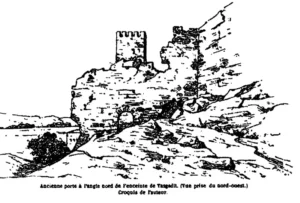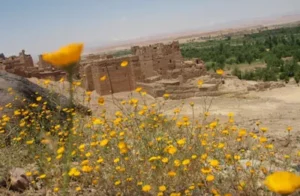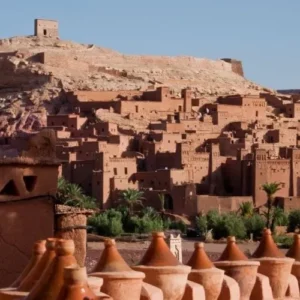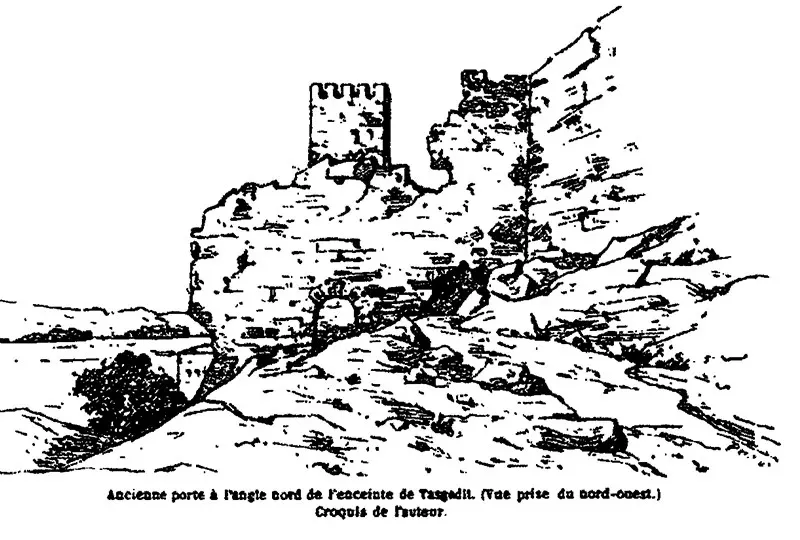
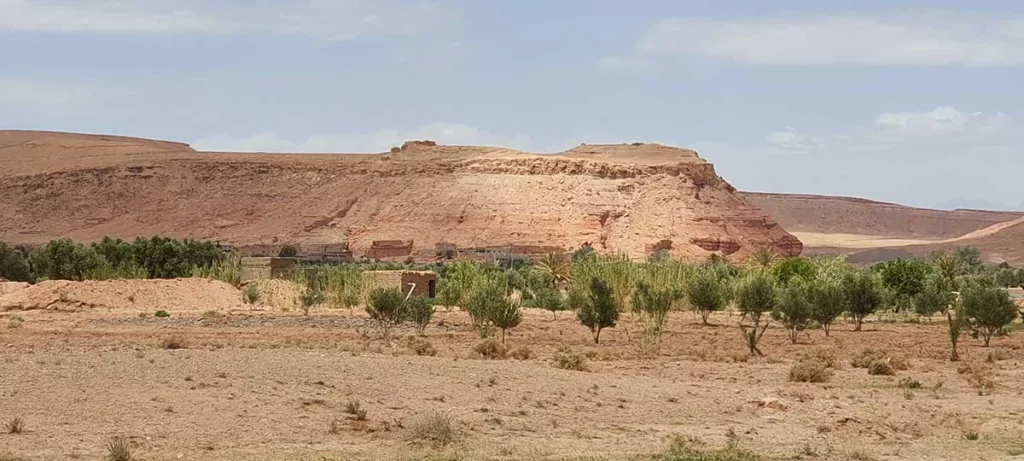
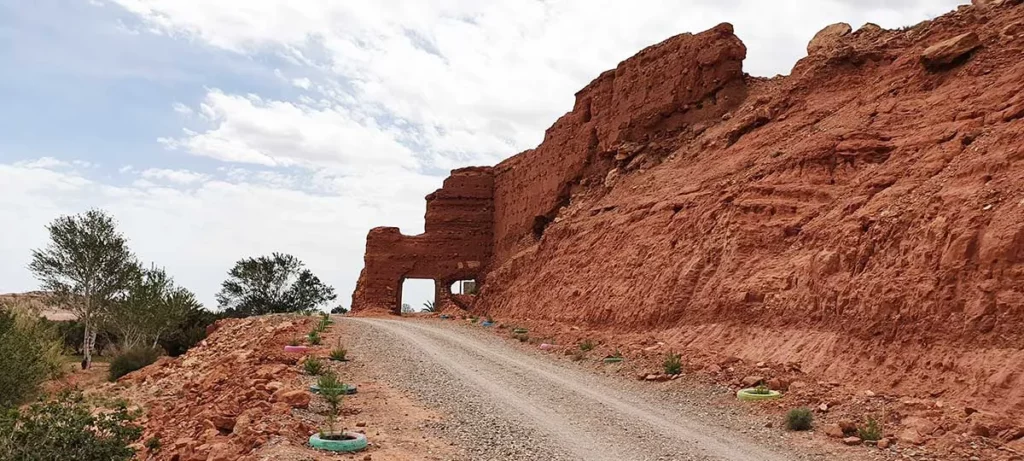
Near Tikirt, in the commune of Aït Zineb, the ruins of Tasgedlt seem almost erased from the landscape. A few walls, damaged towers, a rocky ridge, caverns opening into the cliff: little remains, yet enough for the place to continue speaking.
Charles de Foucauld therefore travelled under a Jewish identity, accompanied by the Moroccan rabbi Mardochée Aby Serour, a guide and interpreter whose knowledge of the terrain and local communities made the expedition possible.
His travel journal, published in 1888 under the title Reconnaissance au Maroc, marked an important stage in European knowledge of Morocco’s interior. It is a narrative that combines geographical observations, notes on tribes, field sketches and fragments of oral traditions.
During a stay in Tikirt, a douar in the commune of Aït Zineb, in the province of Ouarzazate, he discovered the ruins of a mysterious citadel around which local people told strange legends.
Here is his account:
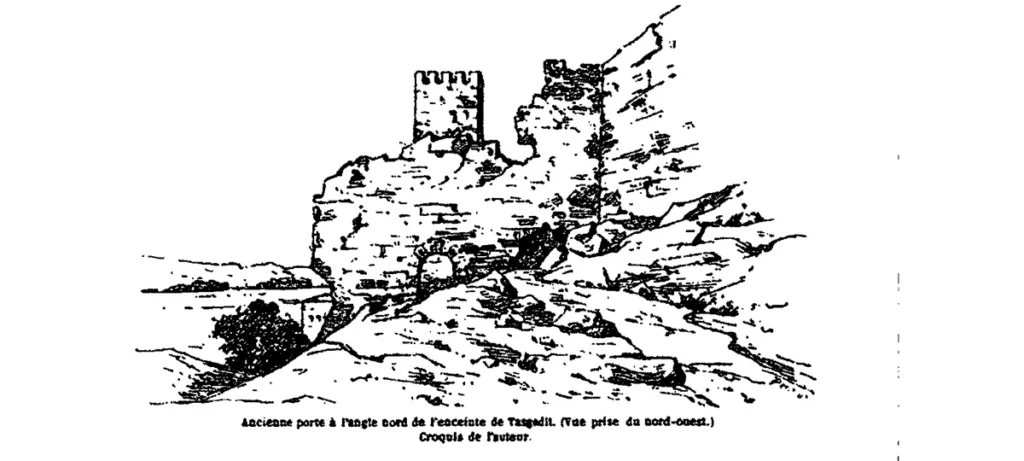
“I took advantage of my stay in Tikirt to visit the ruins of Tasgedlt, famous throughout the region and the subject of a thousand legends. They consist of an almost square enclosure, once lined with towers along its entire perimeter. The thick walls must have been built of masonry at the base and rammed earth above. Little remains of them.
Charles de Foucauld – Reconnaissance au Maroc
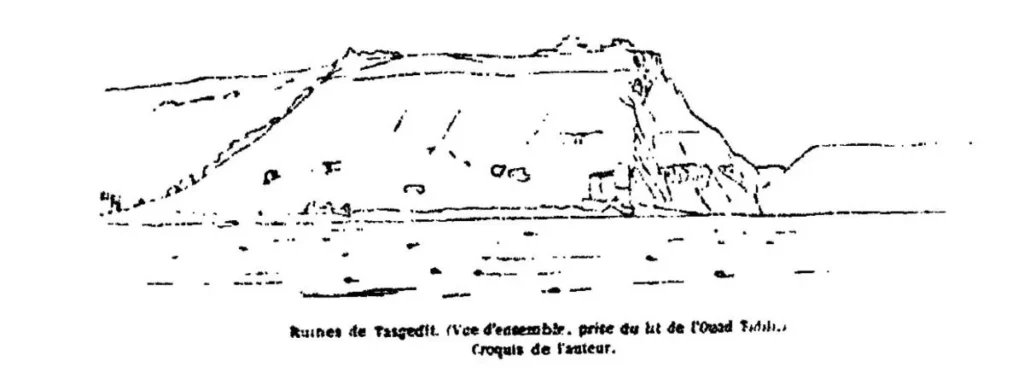
The southern section is the best preserved; there one can still see seven or eight towers, 3 to 4 metres high. (…) The fortress is built in an amphitheatre shape on a rocky slope, which suddenly turns into a vertical wall where the mouths of several caverns open.
An ancient citadel and caverns: for the inhabitants, this is more than enough to see here a trace of the passage of Christians.”
A fortress between myth and history
The remains of Tasgedlt, although now partly destroyed, still suggest the scale of this ancient fortification. Its thick walls, made from a combination of masonry and rammed earth, bear witness to an architectural know-how adapted to the region’s arid climate. Its position, overlooking the landscape, suggests a defensive function. It made it possible to watch over the surrounding area, the passages, the cultivated land and the banks of the Oued Imini. The caverns beneath the citadel may have served as shelters or as places to store food, although their exact function remains difficult to establish.
The people of the region speak of a legend surrounding these ruins:
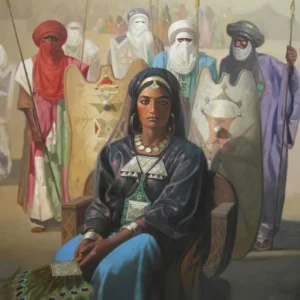
“Many centuries ago, three princesses, daughters of a Christian king, ruled over these lands. One of them, Doula Bent Ouâd, lived in the fortress of Tasgedlt; another, Zelfa Bent Ouâd, lived in a similar one near Asif Marren, at Teççaiout; the third, Stouka Bent Ouâd, lived in a similar fortress at Taskoukt, on the Oued Imini. In these three places, similar ruins still remain.”
Charles de Foucauld – Reconnaissance au Maroc
According to this oral tradition, Muslims waged long wars against these princesses before driving them away.
Charles de Foucauld, however, remained cautious. He himself noted that it was more likely that the three kasbahs were the work of a single sultan, perhaps the one who built the bridge over the Oued Rdat. This remark is important. It does not destroy the legend, but it distinguishes between two levels: on the one hand, oral memory, which gives the place a face; on the other, the historical hypothesis, which links the ruins to political power and to the organisation of the territory.
Collective memory and the remains of a forgotten past
The legends surrounding the citadel have been passed down from generation to generation. In a culture where history is first and foremost transmitted orally, such stories play a fundamental role in the transmission of heritage. The elders of the village still say that strange sounds can be heard at night near the ruins, as if the spirits of the three princesses continued to haunt the place. Some see in these legends a way of preserving the memory of a distant past, where myth and reality are intertwined.
The fortress of Tasgedlt is not an isolated case. Throughout southern Morocco, there are ruins of citadels that once served to defend trade routes. Sites such as Tamnougalt or Tazenakht bear witness to the organisation of these territories, where each fortification played the role of a bastion against invasions or tribal rivalries.
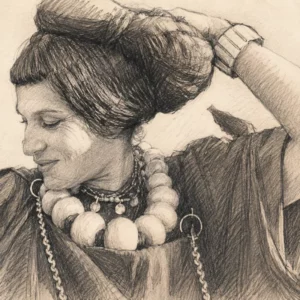
Today, the douar of Tadoula, where the remains of this ancient citadel are found, may preserve in its name an echo of Doula Bent Ouâd, the princess associated with Tasgedlt. Nothing allows this to be stated with certainty, but this proximity between the name of the place and the story handed down gives the ruin a particular depth. Between architecture, oral memory and ancient sketches, Tasgedlt remains one of the most mysterious sites in the region of Ouarzazate.
Read also: The lost destiny of the Jews of South-Eastern Morocco…
Discover all articles: The Berber world