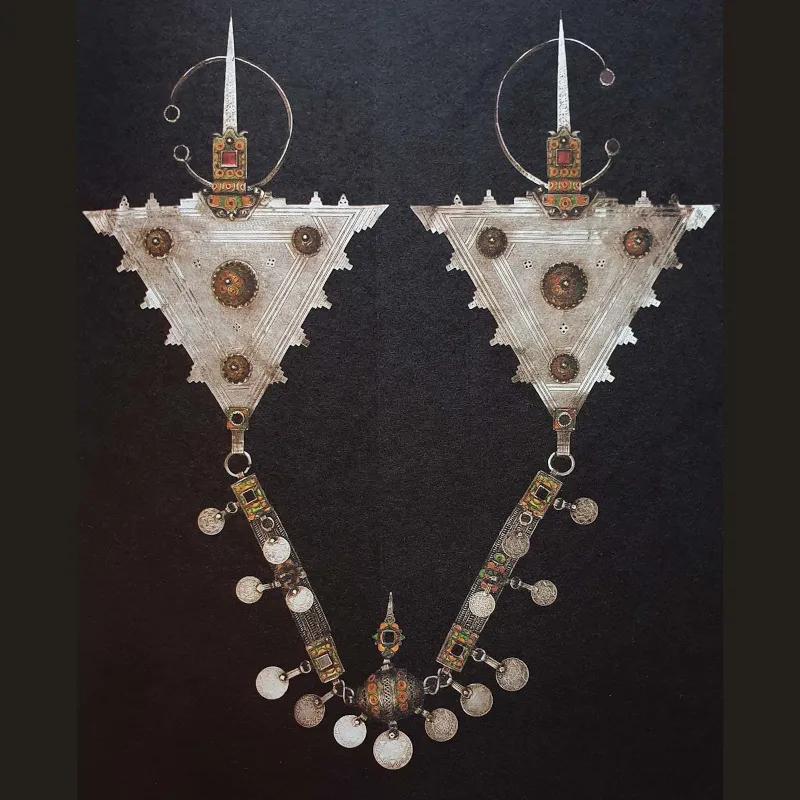
From a simple clothing pin to the centrepiece of a bride’s dowry, the Berber fibula is far more than an ornament. Across the Maghreb, this Amazigh jewel — known by different names depending on the region — has been used to fasten garments, to watch over the fertility of the herd, and to carry the memory of entire lineages. This is the story of a simple piece of metal that became one of the most enduring symbols of Berber culture.
A single object, many names
Archaeological excavations place the use of fibulae as far back as prehistory. In the Maghreb, their presence is documented from the Bronze Age onwards. Similar pieces have been found in ancient Egypt and the Near East — and later among the Etruscans, Greeks and Romans, who used them to fasten their togas. Vikings wore disc-shaped versions to secure their cloaks. The fibula is therefore a near-universal object. What sets it apart in the Berber world is the density of meaning it came to concentrate.
Far more than a clasp
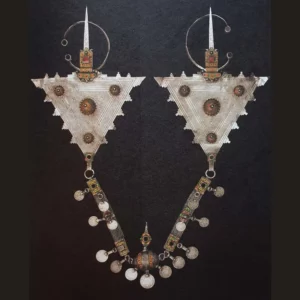
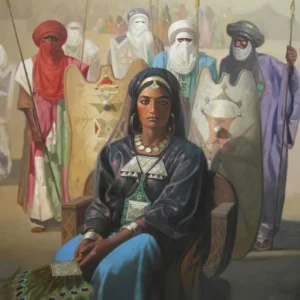
Its primary purpose is practical: the fibula holds fabric in place against the body. Berber women wear it in several ways — in the hair to secure a headscarf, on the chest as a decorative piece, or in pairs at the shoulders to hold the tasselmamt, that broad panel of cloth draped across the back. Simple, effective, indispensable — a safety pin elevated to the rank of jewellery.
But the fibula quickly transcends its utilitarian function. In certain communities of the western High Atlas, a recorded ritual linked this object to animal fertility: when a new heifer entered a home for the first time, the wife would place a silver fibula on the threshold. The animal had to step over it as it passed through. This gesture, charged with symbolic power, entrusted the fibula with the task of blessing the beast and ensuring the prosperity of the household. A simple jewel — and yet a mediator between the human world and invisible forces.
Tribal marker, piece of dowry
It is perhaps in its social dimension that the fibula most fully reveals its depth. As architect and researcher Salima Naji writes in Les Cahiers du Musée Berbère, the fibula visually embodies the feminine in its most fundamental attributes. It is first and foremost a marker of tribal belonging, a visible sign of the wealth and standing of the tribe to which its wearer belongs.
This social weight reaches its height in the wedding ritual. The pair of fibulae forms the centrepiece of the dowry — the lqimt — provided by the father to accompany his daughter. It is not chosen at random: its materials, its size, its ornaments speak of who one is, where one comes from, what alliance is being sealed. To wear one’s mother’s fibula is to wear the identity of one’s lineage.
In certain Berber families, ancient fibulae pass from generation to generation as a sacred inheritance. They carry within them the memory of the women who wore them before, and retain a protective power bound to the blessing of ancestors.
What the materials say
The Berber fibula comes in a wide variety of forms — diamond, circle, triangle, crescent — depending on the region and the era. But it is the materials that reveal its full symbolic complexity.
Silver dominates. It is the noble material of Berber jewellery, associated with purity and protection. The craftsmen who specialised in this work, the isemgan, mastered techniques of casting, repoussé and granulation passed down from father to son. Their social standing was particular: both indispensable and set apart, often belonging to distinct communities within Amazigh society.
Red coral holds a place of its own. Imported from the Mediterranean along caravan routes, it served far more than decoration: its colour and distant origins made it a powerful talisman against the evil eye. Combined with semi-precious stones and geometric motifs — spirals, lozenges, dots — it transformed the fibula into a genuine shield worn against the body.
These motifs are not decorative in the Western sense. They are apotropaic: they ward off evil, attract good fortune, protect the woman and her children. Each symbol answered to a code that the women of the tribe knew how to read.
A craft under threat
Today, the Berber fibula faces a paradox. It attracts growing interest in the worlds of fashion and design — Western designers draw inspiration from it, tourists seek it out in the souks, online platforms offer copies from India or China that reproduce the forms without grasping their meaning.
Meanwhile, the true isemgan — those who have mastered the ancestral techniques of silver jewellery — are disappearing. Ancient fibulae leave Berber families for the antique dealers of Marrakech or private European collections. Transmission is breaking down, silently.
This is precisely why the fibula deserves better than a place in a display case or an ethnic fashion photograph. It deserves to be understood for what it is: a world-object, where body, family, tribe, memory and the invisible all come together.
Also in The Berber World: : The art of feminine hairstyles among the Aït Atta — another perspective on adornment and identity in the Amazigh world.