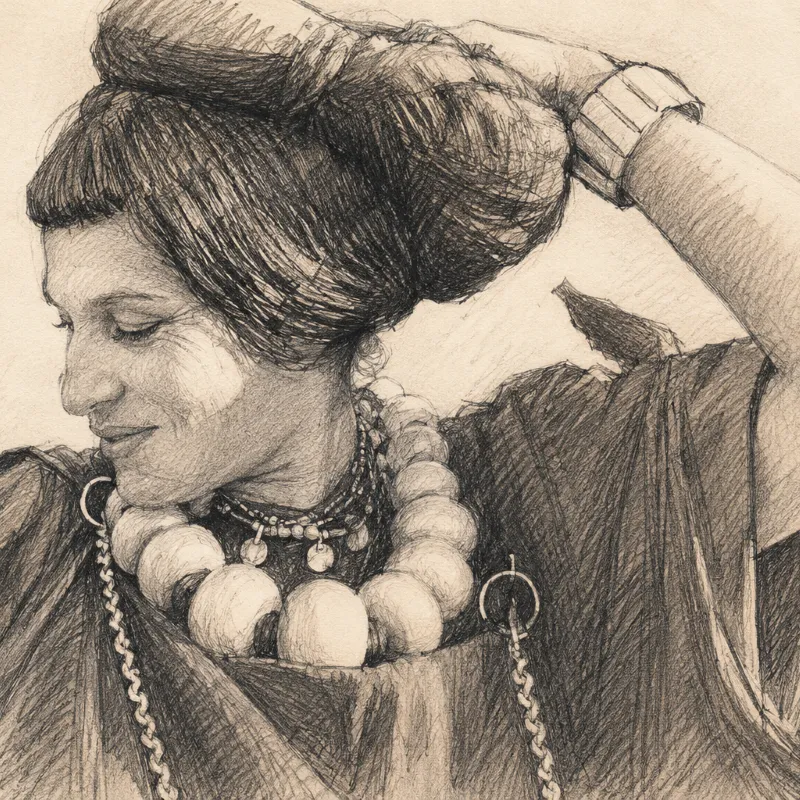
The traditional hairstyles of women from southern Morocco tell far more than a concern for elegance. In the arrangement of a braid, the thickness of a strand enriched with wool, the line of a fringe or the placement of a silver ornament, one reads markers of identity, belonging and memory. Through three ancient portraits of women from the Aït Atta tribes, this article invites us into a body art now largely vanished — yet one whose photographs still retain their full expressive power.
Among Amazigh women of the pre-Saharan regions — the Dadès, Todgha, Saghro, Drâa and Tafilalt — hair was worked with remarkable sophistication. Volume, symmetry, the density of braids, the lines of the forehead, facial tattoos and jewellery together formed a coherent whole in which the body became a medium of cultural expression.
Old photographs are today precious testimonies of a capillary art largely transformed by time.
Who are the Aït Atta?
The Aït Atta are among the largest Amazigh tribal confederations in Morocco. Their historical territory stretched across an immense area, from the Jbel Saghro to the fringes of the desert, taking in the valleys of the Dadès, Todgha, Drâa and parts of the Tafilalt.
Traditionally organised into multiple fractions and tribal groups, the Aït Atta are often distinguished by broad geographical groupings — western, central and eastern. This vast territorial spread explains the existence of cultural variations that are sometimes quite marked, including in women’s adornment.
While language, social structures and certain symbolic codes unite the Aït Atta as a whole, each local group developed its own vestimentary and aesthetic signatures. Women’s hairstyles offer a particularly telling illustration of this.
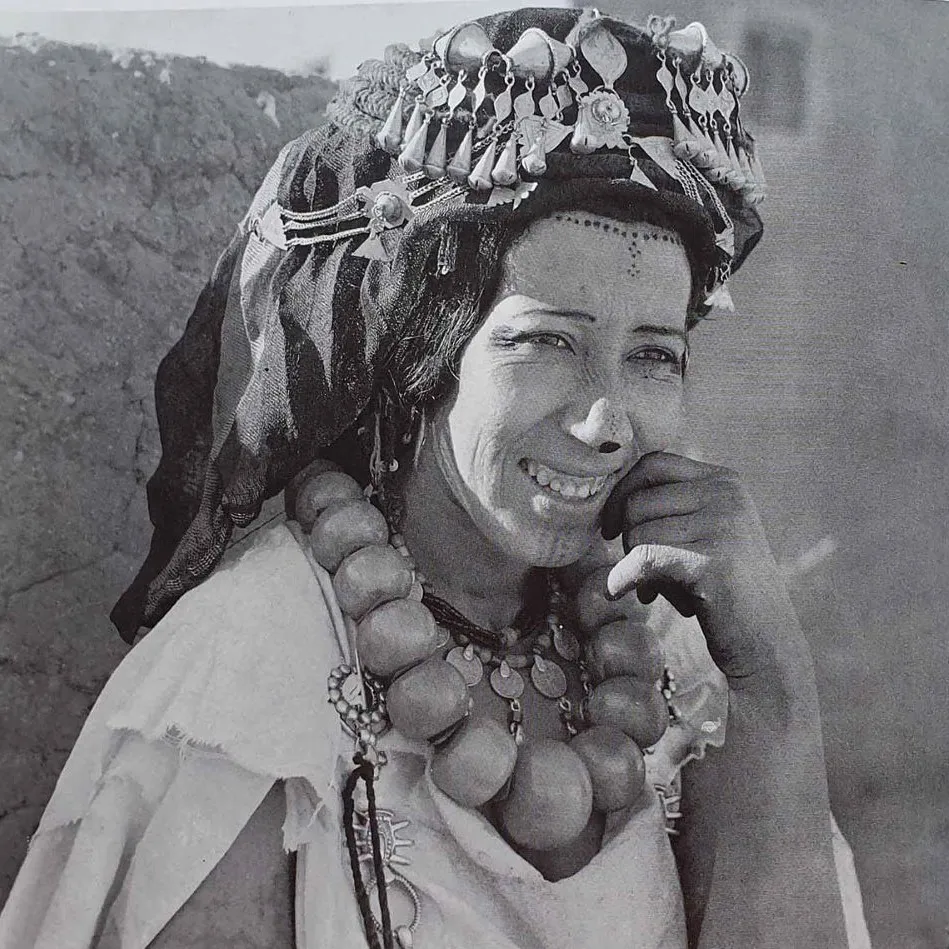
A woman of the Aït Bou Iknifen (Lower Dadès / Lower Todgha)
This young woman from the Aït Bou Iknifen, established in the region of Ouaklim, displays a particularly refined hairstyle, characteristic of the Aït Atta groups of the Lower Dadès and Lower Todgha.
Her fringe, cut very short, draws a sharp line across the forehead. This contour is underlined by a row of black dotted tattoos, interrupted at the centre by a small motif evoking a suspended pendant. Beneath the eyes and along the bridge of the nose appear further tattooed marks, known as tiqifit, which contribute to the ornamentation of the face.
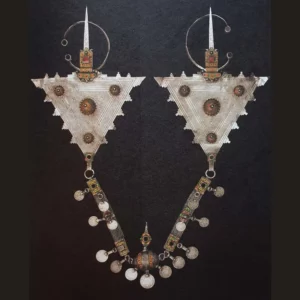
The hairstyle itself is enriched by two imposing silver ornaments. Most striking are the long spindle-shaped pendants ending in tassels, known locally as tiqulalin — literally “little jugs”. These jewels are not merely decorative: they also assert rank, belonging and prestige.
Here, hair, tattoo and precious metal compose an ensemble of remarkable aesthetic coherence.
Read also : The berber fibula: between tradition and symbol
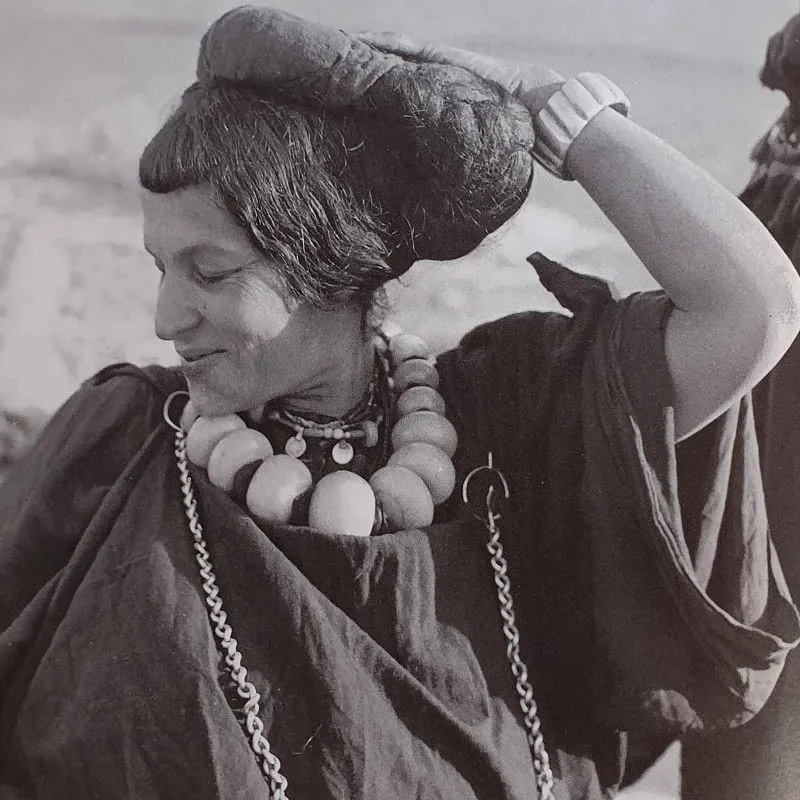
A woman of the Aït Yazza (Eastern Aït Atta)
This woman belongs to the Aït Yazza, a group of the Eastern Aït Atta.
What strikes one immediately is the volume of her hairstyle. To thicken the natural braids, a large quantity of wool has been worked into the hair along its entire length. This technique produces a structure that is fuller, denser and more stable.
The result gives the whole an almost sculptural silhouette. The hair does not simply fall: it is constructed, shaped, architected.
The addition of wool was far from incidental. In many Amazigh societies, it expressed a pursuit of visual presence, formal power and elegance. The hairstyle thus became an extension of clothing and body alike.
Read also : Discovering the Amazigh culture of Morocco
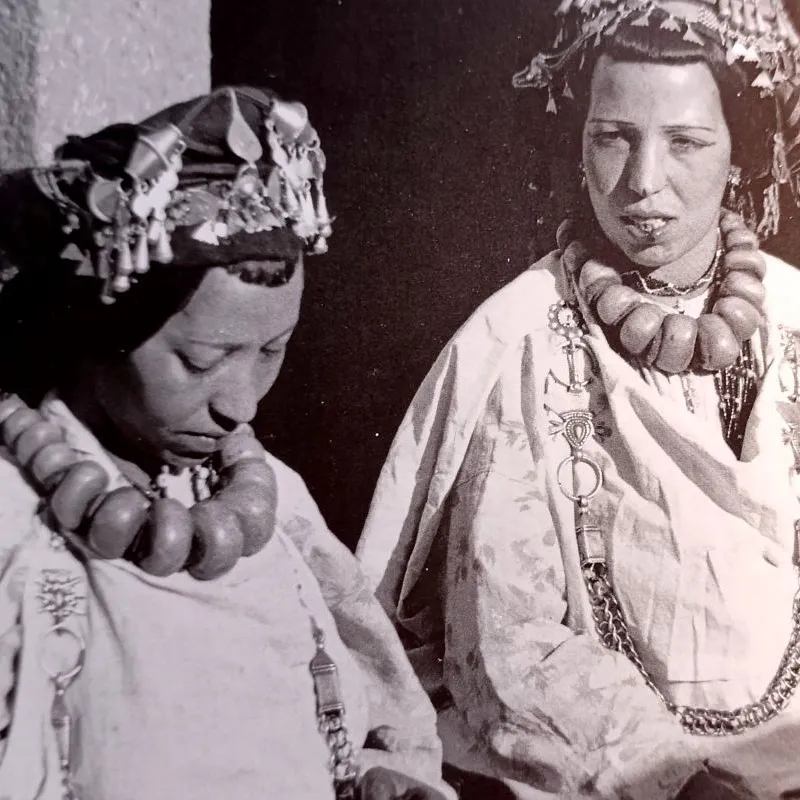
Two Aït Atta women from the Drâa valley
This third portrait shows two women from the Aït Atta tribes of the Drâa valley, in the region of the Ternata. Their hairstyles are close in general structure, but reveal, on closer inspection, distinctly different personal or social choices.
Both wear a headscarf, one sober, the other richly ornamented — a likely sign of different status, or of a particular occasion. Beneath the fabric, bands of hair frame the temples and a rounded fringe traces the contour of the forehead, integrated into the overall composition of the face with the same precision seen in the hairstyles of the western groups.
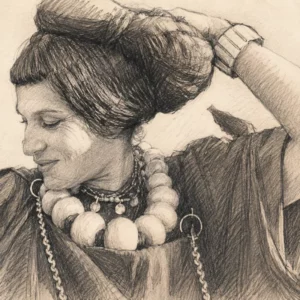
What distinguishes this portrait from the two preceding ones is the way in which the hairstyle partly yields to the ensemble of adornment. Silver jewellery — pendants and necklaces — and rows of amber hold a central place, while the dark lines redrawing the eyebrows and accentuating certain features contribute to an overall ornamentation in which hair and jewellery no longer exist in a hierarchy, but in dialogue.
The Aït Atta group of the Drâa, established among the palm groves and ksour of the Ternata, had indeed developed a feminine aesthetic more oriented towards jewellery than towards capillary architecture alone. The proximity to the great caravan routes — and thus to the circuits of silver and amber trade — partly explains this abundance of precious materials. The hairstyle nonetheless remains structured, legible, charged with meaning: it converses with the jewels rather than submitting to them.
Here too, the ensemble forms a complete aesthetic, in which hair, jewellery, textile and bodily signs express at once elegance, belonging and a certain social ease.
Read also : Glossary of traditional amazigh culture: words of the Berber world
A visual heritage to rediscover
These three portraits represent only a tiny glimpse of the richness of southern Morocco’s aesthetic traditions.
Old ethnographic works are filled with photographs that remain fascinating today: Amazigh women of the Dadès or the Saghro, bridal adornments, tribal jewellery, facial tattoos — but also portraits of women from the ancient Jewish communities of the South, whose vestimentary codes sometimes entered into dialogue with those of their Amazigh neighbours.
So many fragments of memory that deserve to be documented — not out of nostalgia for a vanished world, but to better understand the cultural depth of these territories.
Editorial note
These portraits stop us in our tracks — not out of nostalgia, but because they reveal a sophistication that conventional representations of the Berber rural world have not always acknowledged. A precisely calculated fringe, architectured braids, jewels placed with care: all of this presupposes knowledge, transmission, and above all joy — the pleasure taken collectively by women in the act of adornment, in the shared time of doing each other’s hair, of beautifying, of being looked at and looking.
What has disappeared is not merely a style. It is a right. The right to be seen in one’s signs of belonging — to make visible, through hairstyle, jewel or tattoo, one’s origin, rank and tribe. That right was not swept away by time: it was confiscated by an ideological rigourism from elsewhere, which imposed on Berber women the duty to efface themselves, to conform to a uniform mould in which local identities had no place.
Old photographs have preserved some fragments of this world. It is to Mireille Morin-Barde, author of the reference work Coiffures féminines du Maroc (Edisud), that we owe the preservation of an essential part of it — patient, rigorous work, accomplished in close proximity to the women and the territories. She did not capture this world in its entirety. No one will. What these images show is also what we have lost the right to see.
View all articles : The Berber world