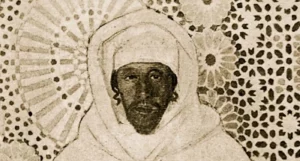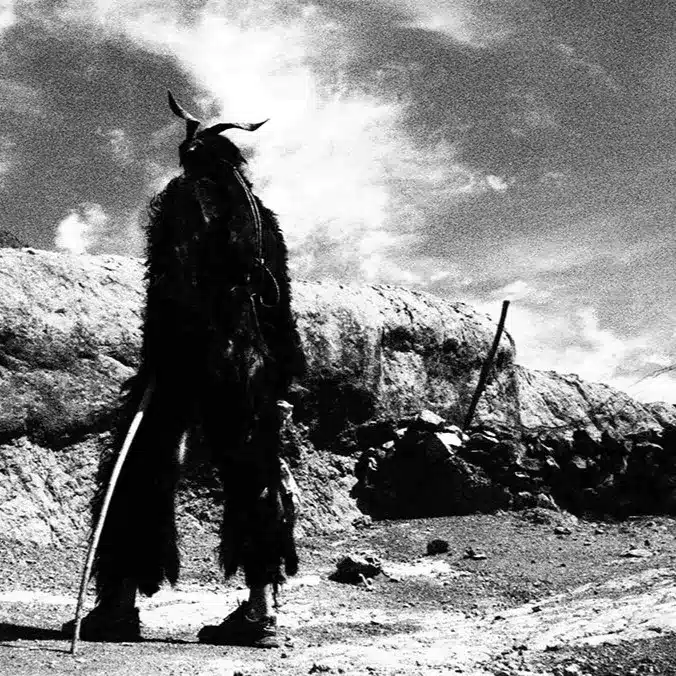
Masked, draped in animal skins, armed with a staff, Bilmawen surges through the alleyways of Moroccan villages in the days following Eid. Heir to ancient agrarian rituals, this half-man half-beast figure embodies a pagan memory of the Berber world — poised between chaos and renewal.
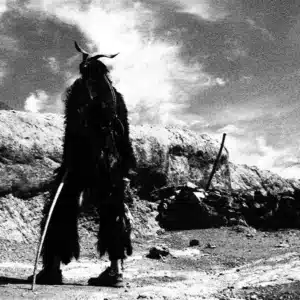
Each year, in the days following Eid Al Adha, a strange figure prowls the alleyways of villages: his body covered in sheep or goat skins, his face concealed or blackened, his head crowned with horns, his step heavy and threatening. He carries a long staff with which he feigns to strike passers-by. Children follow in his wake, drumming, shouting, collecting coins and offerings in exchange for their mercy. He is Bilmawen — the man of skins.
The etymology of the name Bilmawen
The name Bilmawen comes from Tamazight. It derives from the word ilmawen (plural of almu), meaning mask, or covering skin used to conceal the face or body. It refers both to the appearance the figure adopts and to his symbolic function: that of a being who is simultaneously man, beast and spirit.
In other regions, he is known as Boujloud, a dialectal Arabic word formed from bou (“he who has”) and jloud (“skins”). Other local variants exist — Herma, Ayyur, Bou Issafen — depending on the territory and the dialect spoken.
An ancient rite of transformation
Bilmawen does not merely frighten or entertain. He embodies a tradition deeply rooted in North African rural societies: a probable survival of pre-Islamic agrarian rites, associated with the cycles of nature, the deities of vegetation, the symbolic death of winter and the rebirth of spring.
Some anthropologists have drawn comparisons with the Roman Lupercalia, in which men clad in goatskins would strike the crowd to encourage fertility. The parallel remains speculative, but it speaks to the universal dimension of the rite of regenerative transgression.
Among the Amazigh peoples, this tradition also marks a form of passage: the masked figure is a liminal being, hovering between the visible and invisible worlds, between the human and the animal, between social order and sacred disorder.
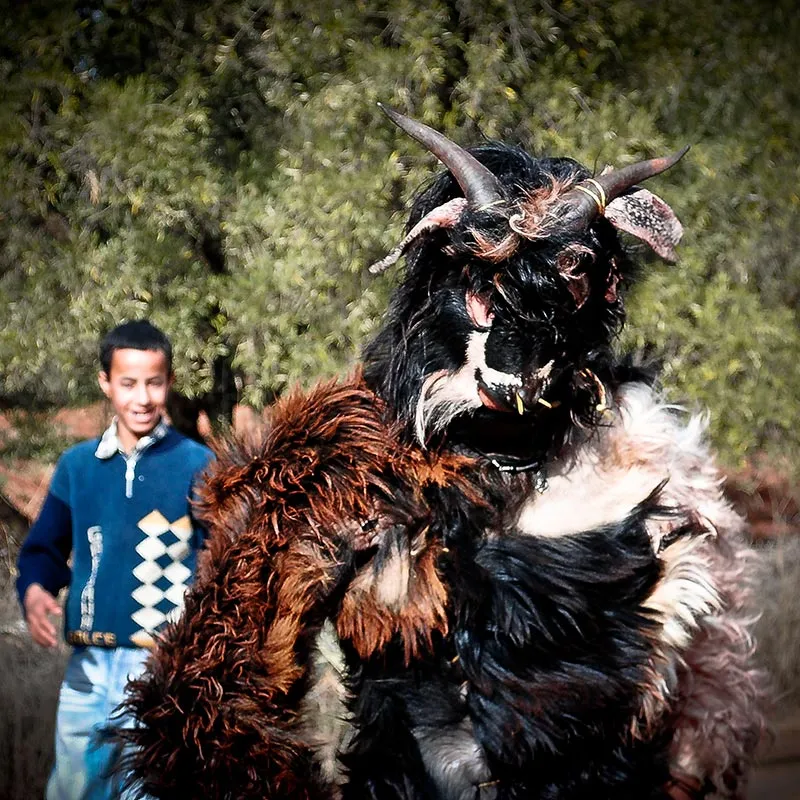
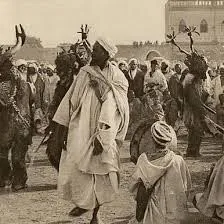
In several villages of the Souss or the Middle Atlas, Bilmawen’s appearances are accompanied by dances, songs, burlesque dialogues and even social satire. He becomes a vehicle for gentle critique — a form of popular theatre in which one may, temporarily, mock the powerful, caricature local notables or ridicule social conventions.
This moment of ritualised freedom is followed by a return to order: Bilmawen disappears, the skins are put away, and everyday life resumes its course.
A memory written in place names
The city of Fès preserves the memory of this figure in the name of one of its most celebrated gates: Bab Boujloud. While the precise etymology remains debated, it is likely that the name refers to this popular character — or at least to the symbolism he carries. Other places across Morocco bear similar names, marking the memorial trace of rites now threatened by forgetting.
Jews and Muslims — a shared memory?
Certain accounts report that Jewish communities of southern Morocco celebrated, during Shavuot, a figure similar to Boujloud — a possible sign of localised festive syncretism between Amazigh traditions and religious rites. While these accounts remain sparsely documented in academic sources, they speak to an ancient cohabitation of imaginaries.
With urbanisation, religious standardisation and the fading of village celebrations, Bilmawen is gradually disappearing. Yet in certain villages of the High Atlas, the Souss and the Rif, cultural associations and community collectives are choosing to revive this tradition — filming it, documenting it, transmitting it to younger generations.
For beneath his skins and his mask, Bilmawen carries more than a simple disguise: he is the breath of a pagan memory, a carnival spirit particular to the Berber World, a masked voice of earth and time.
Read also : Ahwach, the Amazigh tradition of Morocco