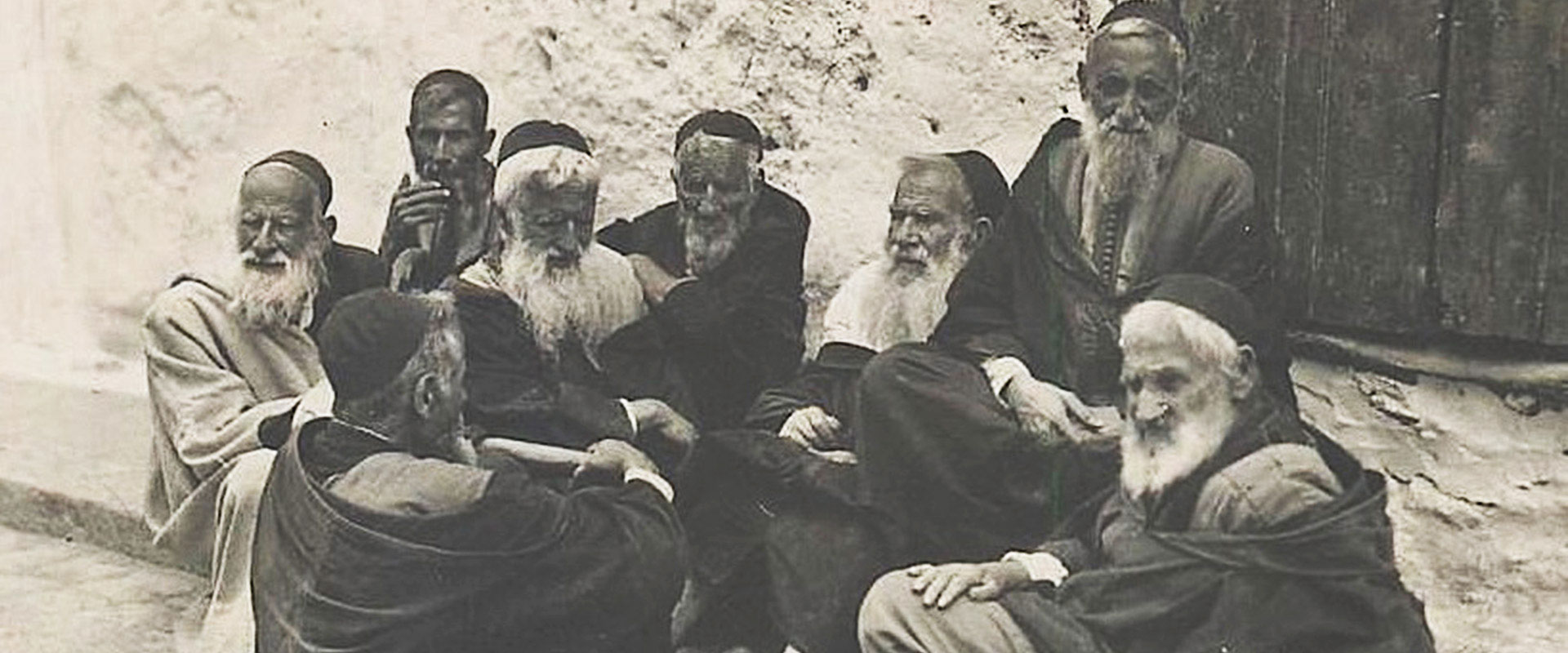
For more than two millennia, a flourishing Jewish community lived in south-eastern Morocco, weaving deep ties with the local populations. Present in the oases, ksour and medinas, Jewish men and women played an essential role in the region’s craftsmanship, trade and cultural life.
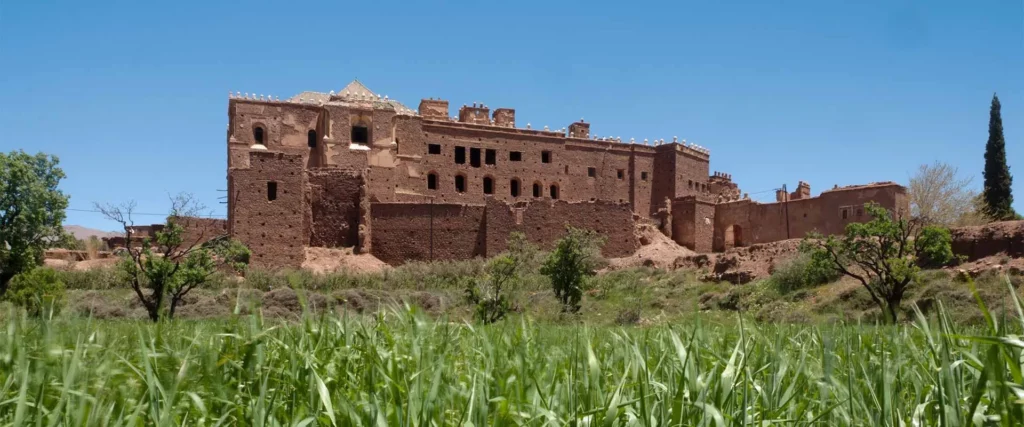
Their presence, long perceived as something self-evident, gradually faded away, leaving behind abandoned synagogues, deserted mellahs and scattered stories suspended between memory and oblivion.
The reasons for their departure were many. Political changes, economic upheavals and new aspirations led to a mass exile towards Israel, Europe and North America. Yet despite the distance, this diaspora has kept an unbreakable bond with its native land, where the echoes of its passage can still be heard.
To rediscover this history is to lift the veil on a little-known facet of Moroccan heritage, and to understand how this legacy continues to shape the identity of the south-east of the country.
Panorama
- The making of a mosaic people.
- The Drâa Valley, a cradle of settlement and influence.
- The Dadès Valley, the Ziz and the whole Tafilalet.
- A symbiosis between Jewish and Muslim communities.
- Jewish know-how in the service of the common good.
- An uprooting marked by heartbreak.
- The eclipse of Jewish communities from Morocco’s national narrative.
- The mystery of this Jew, Moroccan forever, remains intact.
Three centuries later, the founding of Carthage, in present-day Tunisia, intensified these migratory movements. The Greek myths surrounding the giant Atlas, together with the irresistible attraction of the ocean, would forever magnetise both sides of Africa.
Then came the Romans, the Byzantines, the Ottomans, the Arabs. Over the centuries, the lands of north-western Africa became a crossroads of passions and ambitions, an eldorado for every kind of project, a crucible of constant cultural mixing and the workshop of the slow, laborious construction of a country: Morocco.
Very early on, scattered within these human tides, Jewish communities settled here and there, following their wanderings with no other aim than to find a place where they could stop and build a life, often after fleeing another land.
They then took part in the life of their host territories, joining their hands, hearts and intelligence to the labour of the other communities already present, and of those that would join them later. Together, generation after generation, they helped weave the plural identity of what would become Morocco.
The making of a mosaic people
The first waves of Jewish immigration are believed to have arrived aboard Phoenician ships, on the coasts near the mouth of the Oued Noun, in the region of Guelmim in southern Morocco. From there, different groups gradually moved inland, especially towards the valleys of the Drâa, the Tafilalet and the Dadès, and towards the High Atlas.
One legend tells that King Solomon sent Jewish explorers to the Drâa region in the 10th century BC in search of gold. It is also said that some groups may have reached the area directly by crossing the continent at the time of the first destruction of the Temple of Jerusalem in 586 BC, following the mass deportation of the surviving Hebrews to Babylon.
Historically, the only concrete proof of the ancient Jewish presence in Morocco dates back to the 2nd century BC. It consists of funerary objects found in the ruins of the Roman site of Volubilis, bearing inscriptions in Hebrew and Greek.
Until the arrival of Arab tribes from the 7th century onwards, more than a thousand years passed during which Jewish, Berber and sub-Saharan communities shaped a coherent social and cultural space together. Judaism, Christianity and paganism all found expression there, depending on the period, the various local powers and the foreign occupying forces, such as the Romans, the Vandals and the Byzantines.
The growing influence of Islam naturally changed the situation. It protected Jewish communities from the major Roman or Byzantine persecutions by placing them under the status of dhimmi. This social position, discriminatory in practice, nevertheless guaranteed them a real and more bearable form of protection, one that could even become more flexible depending on the mindset of successive sultans, and above all of local chiefs.
While the Almohad period plunged Jews back into persecution, the other sultanates allowed a communal symbiosis to develop between Jewish, Arab and Berber components. This was even stronger in rural areas, where these human groups, brought together, came to form one and the same community. Each retained its cultural singularity, but over time many of these cultures mixed and were transformed.
The German historian, Shlomo D. Goitein, was able to state:
« Judaism has never been in such a strong relational environment and fruitful symbiosis as with the medieval civilization of Arab Islam. »
In Morocco, a common destiny was being forged between these communities, without intention, and even without awareness. It rested both on the unprecedented accumulation of a shared past and on the tragic upheavals of history and of individual lives.
Thus, in the 17th century, Morocco became a land of exile for the three communities together — Berber, Arab and Jewish — then driven out of Andalusia. This forged a certain closeness between them around the nostalgic memory of the Iberian eldorado, and helped enrich their common culture.
The Drâa Valley, a cradle of settlement and influence
Because of its geographical position, south-eastern Morocco was one of the privileged territories for the settlement of Jewish communities. Their presence was so significant that the only documentary sources shedding light on the history of this region before the arrival of Arab tribes are said to be Hebrew manuscripts dating from the 12th century.
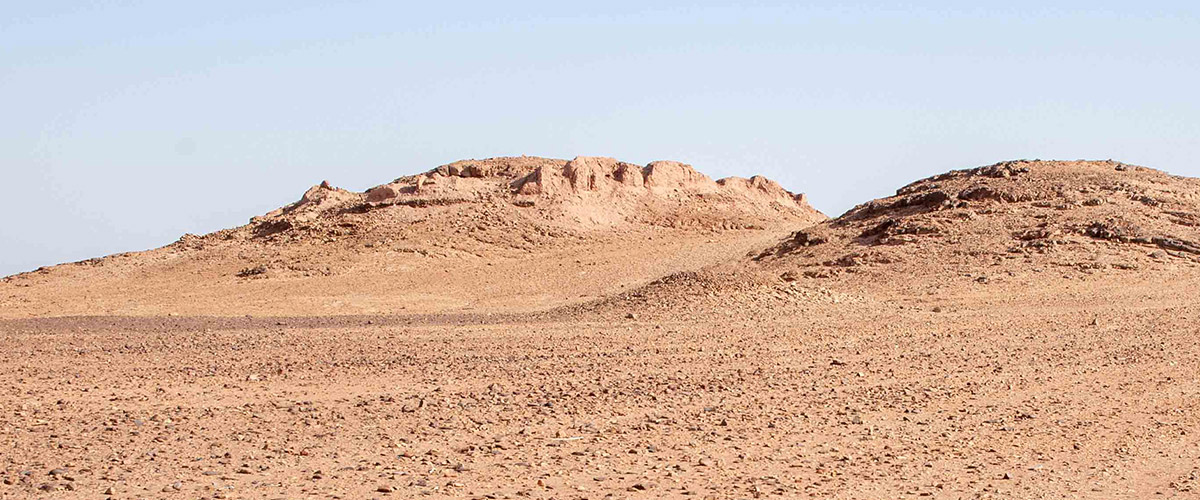
These accounts mention the arrival, around the 5th century BC, of nomadic Jews travelling in camel caravans, and their settlement at the site of Taourirt N’Tidri — the hill of Tidri — near present-day Zagora. Even today, stone and rammed-earth remains can still be seen there, bearing witness to the ancient Jewish presence.
From Tidri, Jews spread to other neighbouring localities such as Beni Sbih and Beni Hayyoun, Amzrou south of Zagora, Asselim N’Ougdz, Tamnougalte, Tazroute, Tagmadarte and Mhamid El-Ghizlane.
Within the flow of these same mythical accounts, mention is also made of the founding of the town of Tamegroute by Jews, as the capital of a Jewish kingdom of the Drâa. This kingdom is said to have dominated the region from the 7th century until the end of the 11th century, when the arrival of the Muslim Berber tribes, the Sanhajas of the Almoravid sultanates, plunged Jewish communities back into a cycle of persecution and definitively deprived them of any possibility of exercising authority over the territories.
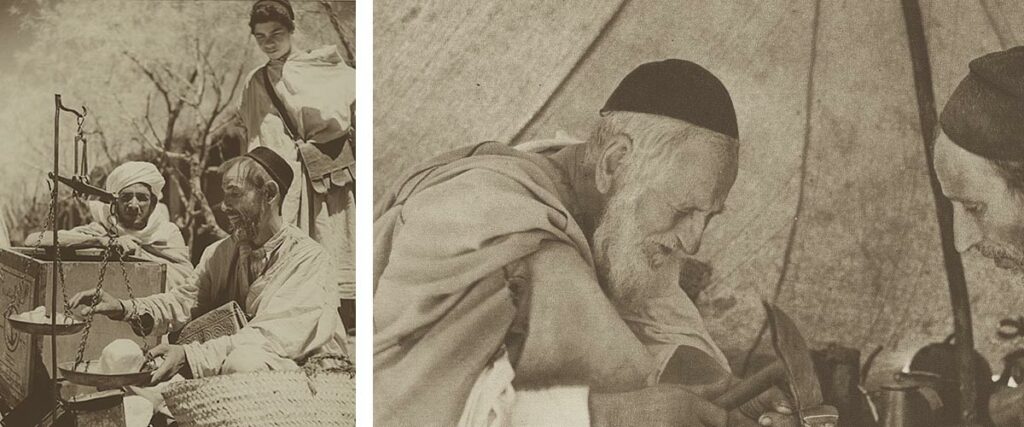
Tamegroute stood out for its urban character and, above all, for its cultural influence. Hebrew learning enjoyed great renown there throughout southern Morocco. The Talmudic scholar Moïse Abraham Halevy Ed-Draoui remains the emblematic figure of this period in the 10th century.
Source : www.ouarzazate-1928-1956.fr
The Dadès Valley, the Ziz and the whole Tafilalet
Important Jewish settlements were also established in the Dadès Valley, notably at Tiylite, a few kilometres from present-day Kelaa M’Gouna.
A 12th-century work entitled Kitâb Al Istibṣar, written by an anonymous Arab geographer, refers to Tiylite as a madina, meaning a town. It describes it as a place through which caravans passed, equipped with a fortress, garrisons and the presence of a wali, or governor.
Tiylite was indeed a point of convergence for populations from neighbouring regions, as shown by the list of families buried in its Jewish cemetery: Ait Ouzzine, Ait Tazarine, Ait Ofilal, Imeghrane, Ait Hnana, Ait Icho, Ait Messoud, Ait David.
The Todgha and Dadès valleys also welcomed large Jewish communities from Andalusia after its reconquest by the Spanish Catholic monarchy. The ksar of Asfalou thus became a major place of residence for the Jews of Todgha, followed by the ksar of Tinghir, Taourirte and Ait Ourjdal.
The importance of the Jews in Todgha is explicitly carried in a local Amazigh popular song:
In Tinghir D’Taourirte D’Asfalou, Oudayn Akent Igan D ’Teqbiline
O Tinghir, Taourirte and Asfalou, it is the Jews who have enabled you to become tribes.
In the Tafilalet, around the Ziz basin, many Jewish settlements prospered. They experienced major economic and social growth with the founding of the city of Sijilmassa by the Zenata Berbers. After the decline of this radiant city in the 14th century, Jews continued their destiny in other ksour, such as the ksar of Tabouâssamte, Almamoun, Alfouqani, as well as the ksour of Beni Moussa and Moucheqlal.
Read also : Sijilmassa, the mythical city that shone the true heart of the Maghreb
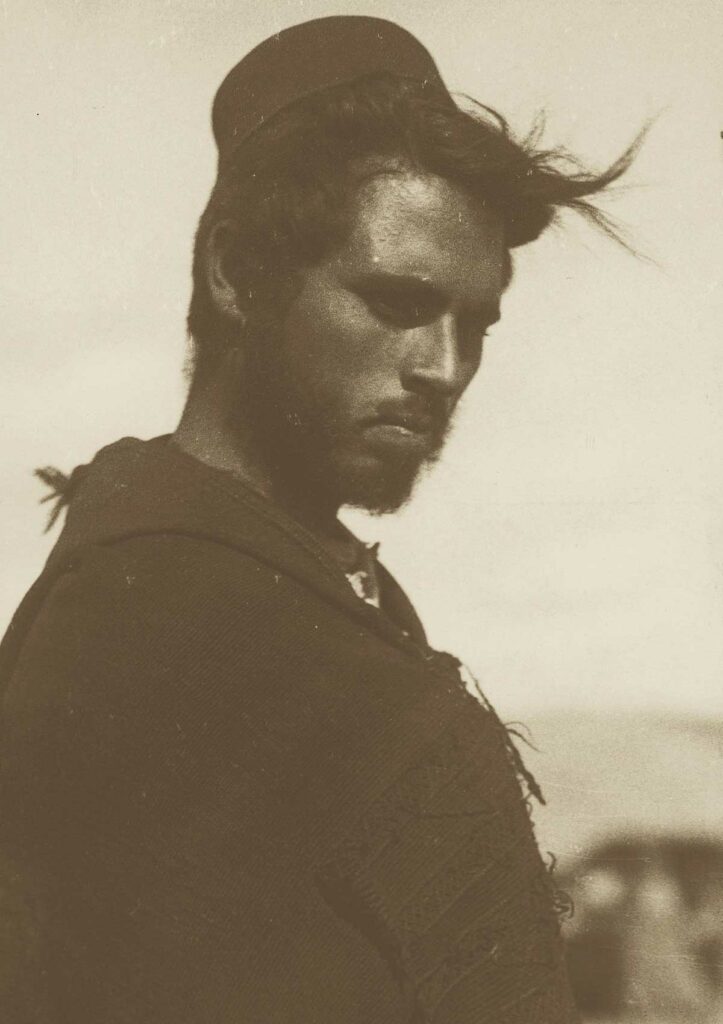
The Tafilalet is also the native region of great Jewish rabbis such as Rabbi Ya’akov Abehssera, born in Rissani in 1889, Rabbi Moul Tria and Rabbi Moul Sedra.
The names of Jewish families still echo in local collective memory: Benchetrit, Benitah, Bensemhoun, Dahan, Illouz, Mamane, Nezri, Teboul Hazout, Bensaid, Zenou, Amoyal, as well as the Benhamou and Azeroual families in Boudnib.
Once the establishment of mellahs became the norm in Morocco’s major cities from the 19th century onwards, the towns and villages of south-eastern Morocco also created these areas reserved for Jewish communities. Some of them gained considerable renown, such as those of Rissani, Erfoud and Demnate.
More info
- A mellah (Arabic: ملاح, romanized: Mallāḥ, lit. ’salt’ or ‘saline area’; and Hebrew: מלאח) is the place of residence historically assigned to Jewish communities in Morocco / Source : Wikipedia
Ouarzazate, too, was home to significant Jewish populations, notably in the villages of Telmasla, in the Kasbah of Taourirte, in Tamassinte, Imini and Tikirt. Rabbi Yihia Ben Baroukh Cohen Azogh rests in Tifoultoute. Agouim also hosts the tomb of Rabbi David Ou Moshé, born in Jerusalem. The village of Tazenakhte was especially renowned for the presence, in its synagogue, of an important theological document known as the Sefer Tislit, or the Scroll of Tislit.
A symbiosis between Jewish and Muslim communities
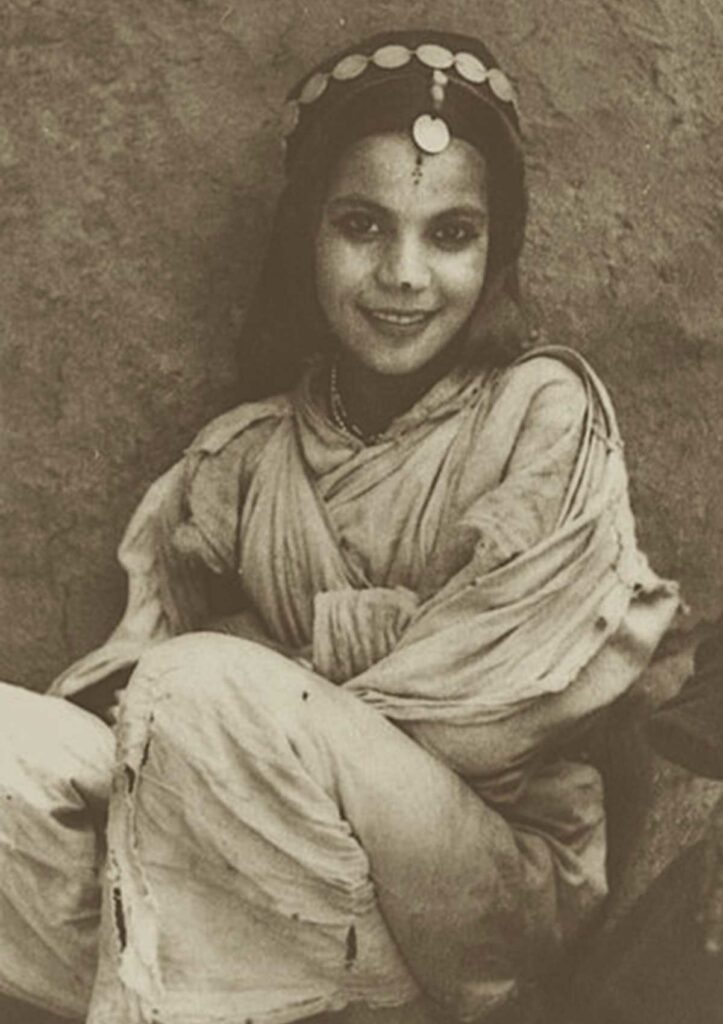
Jews and Muslims therefore shared a common existence within an equally common destiny. This fusion gave rise to a mixed culture, Judeo-Berber-Arab in character, in which many elements of identity were shared, such as the veneration of saints and ritual ceremonies around their tombs. On the Muslim side, this was the Moussem; on the Jewish side, the Hiloula. Often, the two communities venerated the same saints under different names.
Thus, in the Drâa region, Jews and Muslims celebrated a pilgrimage to the tomb of the same saint in Tidri, known as Isaac Akkouim by Jews and Sidi Moussa by Muslims. In Demnate, another saint named Haroun Ben Cohen was also venerated by local Muslims under the name Bou Lbarakat, meaning “the one who grants blessings.”
More info
- Moussem : an annual regional festival combining a religious celebration in honour of a saint with festive and commercial activities.
- Hiloula : its primary meaning is “to cry out with joy and fear.” It refers to a Jewish custom of visiting the tombs of tzaddikim, the Just Ones, on the anniversary of their death, commemorating them through a festive ceremony. (Source : Wikipedia)
This cultural harmony between Jews and Muslims is also illustrated by family names, since only a small minority of Moroccan Jewish surnames have Hebrew or Aramaic roots. Most Jewish names reveal a local Berber, Arab or sub-Saharan connotation, or refer to a profession, a tribal affiliation or a geographical origin.
Jewish know-how in the service of the common good
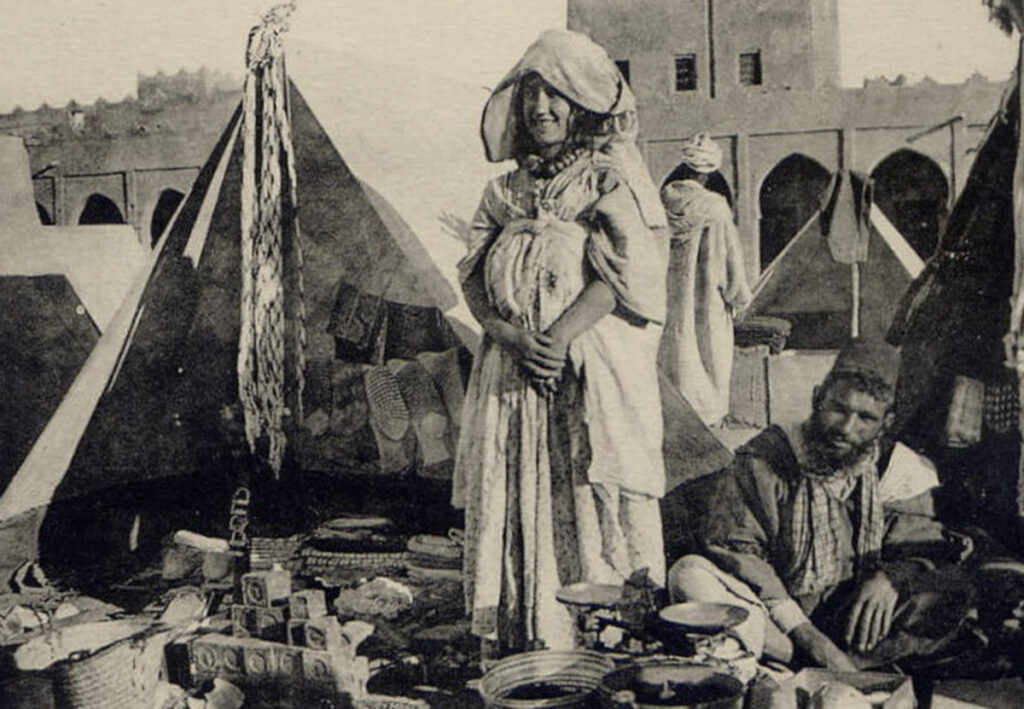
While Jews in the great imperial cities often played important political and economic roles with the sultans, as influential advisers, financial managers or diplomatic agents, their role in the territories of the south-east was crucial to the development of localities and the organisation of their economies.
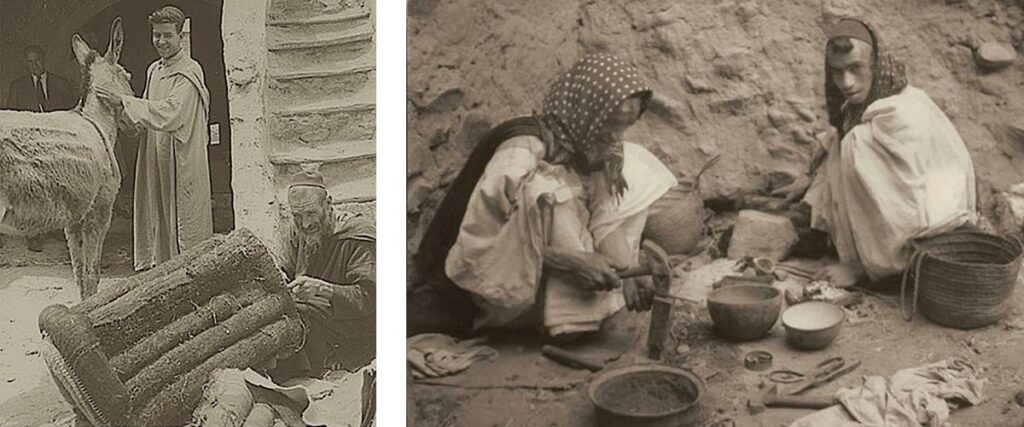
The prosperity of trans-Saharan trade rested largely on their involvement, thanks to their ancestral knowledge of the desert and of nomadic life. This know-how, together with their command of local languages, allowed them to open routes between remote regions, enabling their artisans to take part in weekly souks: blacksmiths, goldsmiths, gunsmiths, locksmiths, tailors, shoemakers, makers of saddles and babouches, carpets and blankets.
A perfect example is given by Rabbi Mardochée Aby Serour of Akka, who accompanied the French explorer Charles de Foucauld during his reconnaissance journey through Morocco in 1883.
Around the year 1070, the Andalusian geographer Al-Bakri described the Jews present in Sijilmassa as specialists in masonry and architecture. Throughout south-eastern Morocco, they were indeed the builders of many kasbahs and ksour, and the engineers of many agricultural facilities, especially those related to irrigation.
But it was in trade that Jews naturally acquired lasting skill and reputation. A popular saying illustrates this beautifully:
The Jew in the souk is like leaven in bread.
Popular saying
An uprooting marked by heartbreak
The 20th century would bring profound upheavals to the communal fabric that had been woven over the centuries between the Jewish and Muslim communities of Morocco.
On the one hand, the French Protectorate encouraged the rural exodus of Jewish families towards the major cities, drawn by access to Western modernity and no doubt by a hope of emancipation. On the other hand, France supported the development of modernised education based on the secular model of the French system.
The Alliance Israélite Universelle, a French organisation, thus offered mass schooling to young Jewish girls and boys, including those from the poorest families, and therefore also in rural Morocco.
The second half of the 20th century, from Morocco’s independence onwards and in the context of the various conflicts between Israel and the surrounding Arab countries, saw the departure from Morocco of the immense majority of Jews, even though they had become Moroccan citizens.
Mrs Fadma, originally from Ouarzazate, who died during the Covid-19 lockdown at the age of around 120, recalled those moments of separation with regret:
« The Jews mostly lived in the village of Telmasla. They were never our enemies. We lived together. I still remember that day when buses arrived in our villages to take them. We all gathered to say goodbye to them. It was a sad day. »
Mrs. Fadma
The eclipse of Jewish communities from Morocco’s national narrative
More than two thousand years later, the traces of the Jewish communities in south-eastern Morocco are gradually disappearing. They can still be found in the names of certain villages, in family names, in popular legends and in local customs.
Although oral tradition still manages to preserve some memories of all these shared communities of life between Berber, Arab and Jewish populations, time may erase them forever if nothing is done to highlight and preserve them, further eclipsing the Jewish share in Morocco’s national story.
The history of this participation of Jewish communities in the construction of Morocco remains little known, especially among younger Moroccan generations. Some initiatives have emerged in certain major Moroccan cities to counter this historical amnesia and restore all its colours to the collective story. Here in south-eastern Morocco, however, as with so many other facets of this region’s rich mosaic of memory, nothing has yet been done.
More info
- Tinghir-Jerusalem: a film directed in 2013 by Kamal Hachkar, who is originally from Tinghir. It tells the story of an exile, from Tinghir to Jerusalem.
- Bayt Dakira Essaouira: the House of Memory is a new museum in Essaouira and a research centre officially inaugurated by the King in January 2020. It is dedicated to preserving the memory of the Jews of Essaouira.
The testimony of a Moroccan Jewish woman who left for Israel expresses a clear wish:
“I want young people to know the history of Moroccan Jews. In the villages, Jews and Muslims were full brothers. The Jewish mother breastfed the baby of the Muslim mother, and vice versa. We never abandoned our country.
Fanny Mergui, born in 1944 in the medina of Casablanca
Three generations of Jews of Moroccan origin have now been born in Israel, and grandparents, together with their grandchildren, travel every year to Tinghir, Skoura, Errich and elsewhere to pray at the tombs of their ancestors and their tzaddikim, their saints.”
The mystery of this Jew, Moroccan forever, remains intact
In the end, once the pilgrimages have passed and all memories have faded, there will remain the indelible scar of the heartbreak caused by the mass exodus of the Jewish community.
The heartbreak of entire families torn away from a land that had become native to them — and even more than that, a land of origin.
The heartbreak of being removed from a country that had become theirs.
And finally, the heartbreak felt by all those who watched leave the men and women with whom, despite everything, despite periods of persecution, constraints and humiliations, they had shared, over the centuries, the experience of having become Moroccan.
The history of Jews in Morocco thus unfolds across a very long path where light and shadow intertwine, faithfully reflecting the journey of our shared humanity. Yet one singular fact can be observed, and every testimony confirms it: the Moroccan Jew, whether from the south-east, from other rural regions or from the great cities, has left. But wherever he may be in the world — in Israel, in Europe, in Canada or anywhere else — he keeps his Moroccan component present and alive within him.
Between the suffering and the beauty of his existence in Morocco, the mystery of the Jew, forever Moroccan, remains intact.
This mystery undoubtedly sheds light on the past of all Moroccans and of all Moroccan territories. It could also illuminate their future, if the awakening of memory could be understood as the illumination, in all its colours, of the great and beautiful history of Morocco — a kingdom then fully proud of its plural identity.