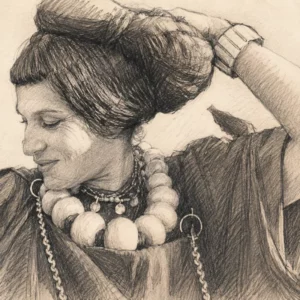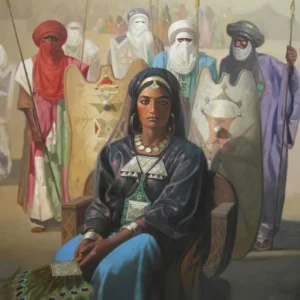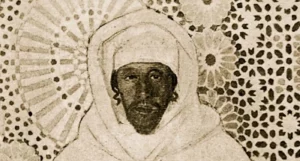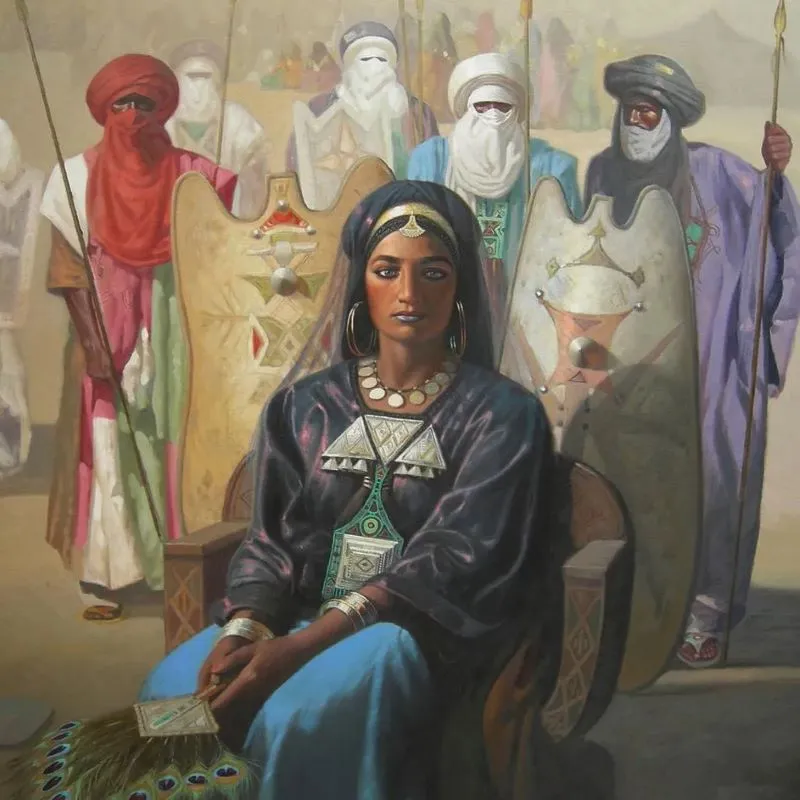
Etymologically, her name means “she of the journeys” or “the woman of the tents.” Tin Hinan was a Tamenokalt — a chief of the Tuareg confederation. In the Hoggar, she is still honoured as the founding matriarch, affectionately known as “Our Mother to All.”
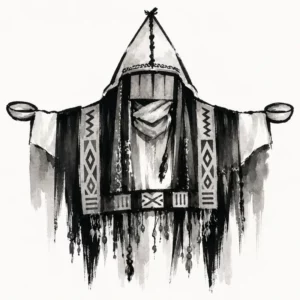
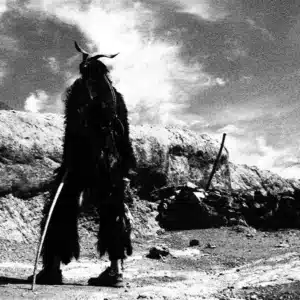
Found today across Niger, Mali, Algeria, Libya and Burkina Faso, the Tuareg represent a living extension of the Berber world, adapted to the vast desert expanses of the Sahara — where it is the men, not the women, who wear the veil: the tagelmust, dyed with indigo, which earned them the nickname “Blue Men“.
A princess from the Tafilalet
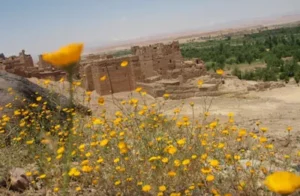
According to oral tradition, Tin Hinan originated from the Tafilalet, in southeastern Morocco. For reasons that remain mysterious — political flight, dynastic conflict, the search for new territory — she left her homeland atop a white camel, accompanied by her servant Takamat and a caravan. The story tells that the two women nearly perished crossing the Sahara, saved at the last moment by the discovery of grain in desert anthills — an episode that remains celebrated in Tuareg oral tradition.
After this long crossing, she reached the Hoggar, in the heart of present-day Algeria, where she settled at Abalessa and founded her lineage. According to legend, Tin Hinan gave rise to the noble Kel Rela tribe, while her servant Takamat became the ancestor of vassal tribes. Other accounts, gathered from different Tuareg confederations, attribute this founding lineage to other female figures — a sign that each group constructs its own mythical genealogy around a founding mother.
The 1925 archaeological discovery
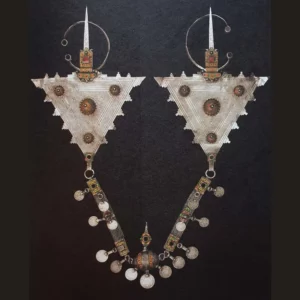
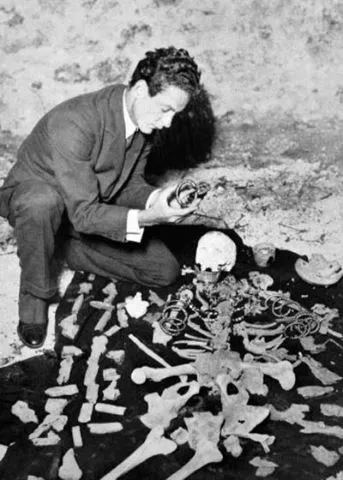
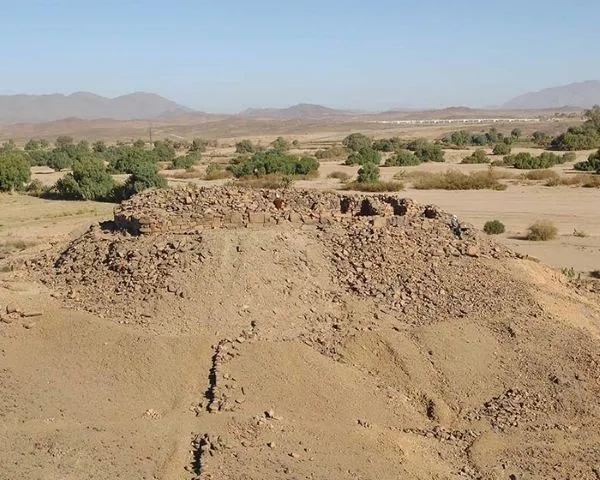
A major turning point in this story came in 1924: a Franco-American team uncovered a monumental tomb on a hill overlooking the Oued Tifirt, near Abalessa, not far from Tamanrasset. In 1925, excavations revealed the skeleton of a woman, accompanied by exceptional funerary goods for the region: pearls, gold and silver jewellery crafted using techniques of North African influence, and — a detail that would long fuel the mystery — Roman coins bearing the effigy of Emperor Constantine.
Analysis of the skeleton also revealed a slight limp, leading some researchers to draw a connection with “Tiski the lame,” mentioned by the historian Ibn Khaldun as early as the 14th century. The ethnologist Marceau Gast even suggested that the woman buried there may never have had children — a troubling detail given her status as founding mother in oral tradition.
Legend or history? A debate that remains open
It must be said honestly: the identification of the Abalessa skeleton as Tin Hinan remains debated among scholars. Some specialists, following Marceau Gast, have suggested that the legend of Tin Hinan may be a later construction, shaped by the Kel Rela confederation to legitimise their political supremacy within the Hoggar — a founding figure crafted after the fact rather than a direct historical memory.
Whether or not the woman buried at Abalessa truly was the Tin Hinan of oral legend ultimately matters little to understanding what this figure represents. She remains, in the Tuareg imagination as in that of the wider Berber world, the symbol of a lineage traced through women, of a founding migration that began in the Moroccan Tafilalet, and of an ancient bond between two shores of the Sahara — the oases of southeastern Morocco and the Hoggar of Algeria.
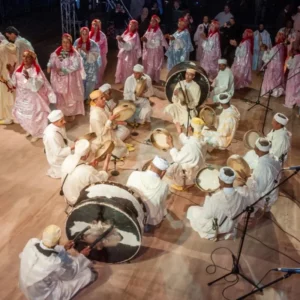
Read also : Ahwach, the Amazigh tradition of Morocco
A living place of memory
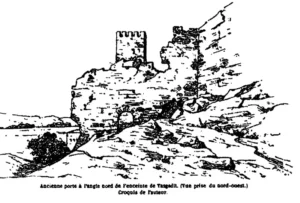
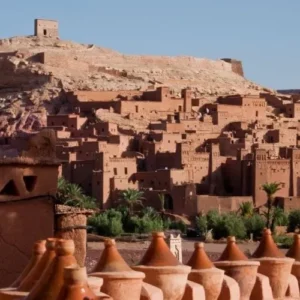
The mausoleum at Abalessa, now known as the Tomb of Tin Hinan, remains for the Tuareg a place of memory and lineage. Its silhouette, reminiscent of the funerary architecture of the Tafilalet and Mauritania, testifies to a Berber style shared across the Sahara. The site continues to be the subject of archaeological campaigns seeking to better understand its true origins, while the remains attributed to the queen are today preserved at the Bardo Museum in Algiers.
For the Tuareg, Tin Hinan remains far more than a historical figure: she is a living source of inspiration, invoked in oral poetry, present in stories passed down through generations, and still called upon as the symbolic mother of a people who, from the Moroccan Tafilalet to the far reaches of the Hoggar, have never stopped tracing their own path across the immensity of the desert.
Also in The Berber World: : The berber fibula: between tradition and symbol — another perspective on adornment and identity in the Amazigh world.