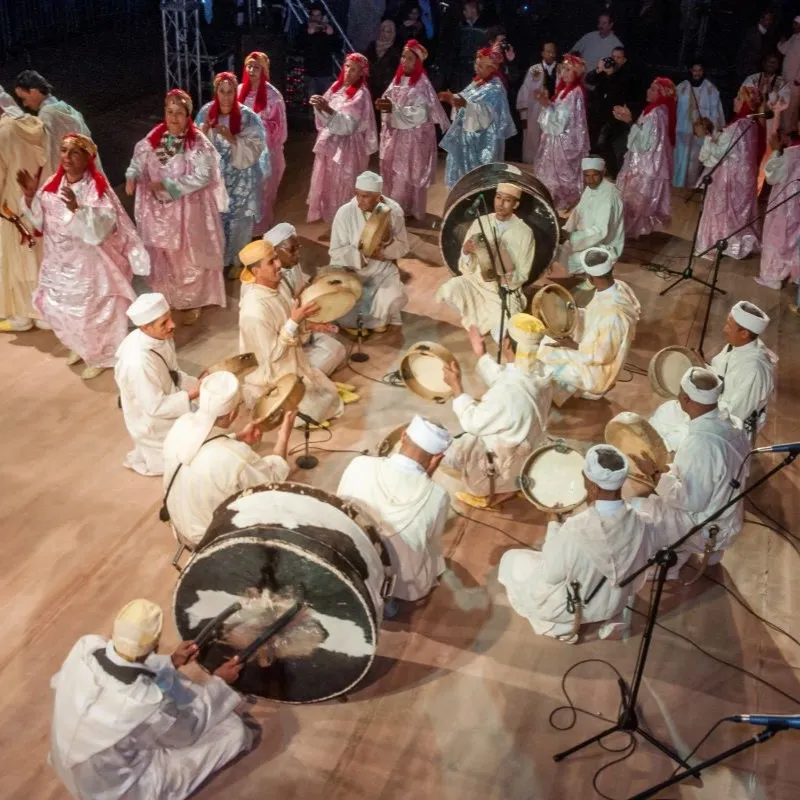
One summer evening, on the village Assarag, drums wake before the stars. Men close ranks in a circle; the Anksalim’s voice rises, low and insistent. Then women step in, and the Amazigh circle closes on itself, ready to turn until dawn.
The circle at the heart of Ahwach
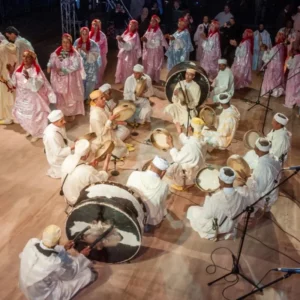
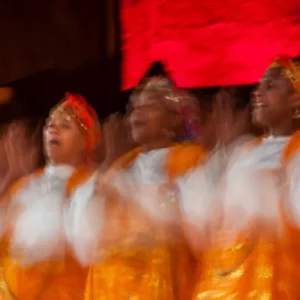
Men dressed in white take the center, drums and tambourines in hand. One of them, the Anksalim, opens the chant in a deep, haunting voice: Ahwach begins. Women then form a circle around them, ululations and tambourine beats marking the start.
The rhythm builds in waves. Bodies sway, and improvised poetry drifts from the sacred to the profane — invocation, a search for origins, confessions of the heart. Three instruments carry this rise: the taguenza (a wooden-frame tambourine), the dendoum (a double-headed cylindrical drum), and the naqouss (a metal gong struck with sticks).
Costumes, poetic duels, and colonial-era travelers’ accounts feature in our in-depth piece: Ahwach, the Amazigh Tradition of Morocco.
Ahwach and Ahidous: one pulse, two territories
People often mix up Ahwach with its Middle Atlas cousin, Ahidous. Both share the same grammar: circle, chant-and-drum alternation, poetic duel. But each carries the pulse of a different territory.
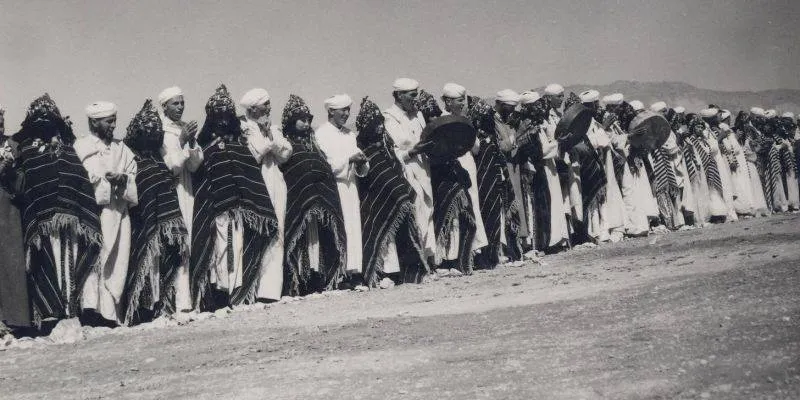
Ahidous belongs to the Tamazight-speaking tribes of Khénifra, Azrou, and Imilchil. Men and women dance elbow to elbow, in tight rows or blocks, to sung verses called izlan, kept by a single bendir and handclaps.
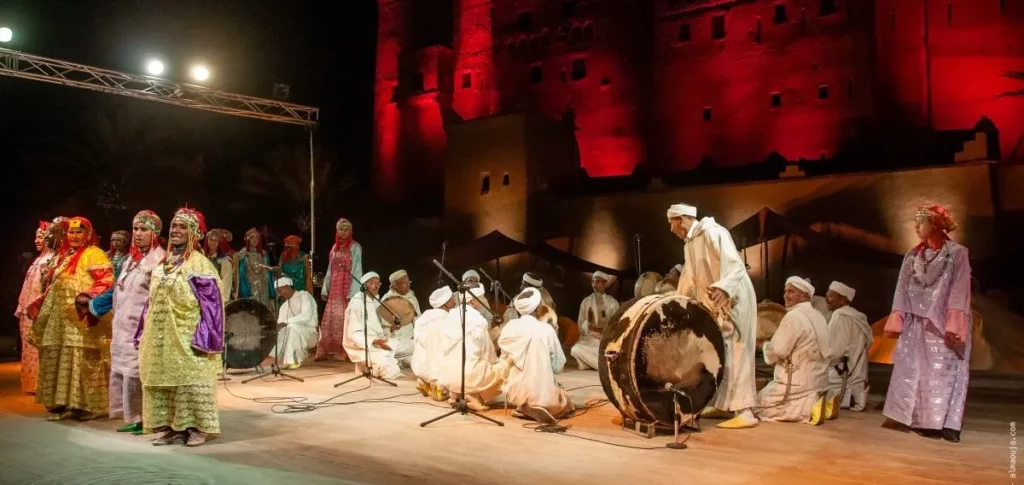
Ahwach belongs to the Tashelhit-speaking world of the Chleuh. Men hold the center of the circle, the percussion runs fuller, and the women’s ring can split into two facing rows that answer each other — a choreographed dialogue Ahidous doesn’t share in quite this form.
Two territories, then, for one shared impulse: turning the collective circle into the place where Amazigh speech is spoken and passed on.
A living heritage, still seeking recognition
Each year, a National Festival of Ahwach Arts brings troupes from across the kingdom to Ouarzazate, under the Ministry of Culture’s patronage — a rare showcase for an art still carried mostly by oral transmission.
Unlike the Taskiwin, a martial dance of the western High Atlas inscribed on UNESCO’s Intangible Cultural Heritage list in 2017, Ahwach has yet to earn that recognition, despite advocacy from researchers and practitioners over the years.
The gradual loss of the art’s great masters raises the stakes. University initiatives, notably around Ibn Zohr University, now work to archive voices and gestures before they fade.
Discover all articles: The Berber world
Key Takeaways
- Ahwach is a collective dance of the Amazigh communities of the western High Atlas, the Anti-Atlas, and the Souss, blending chant, improvised poetry, and percussion.
- Typical structure: men hold the center (percussion and opening chant), women form a circle around them.
- Three main instruments: taguenza, dendoum, naqouss.
- Not to be confused with the Middle Atlas Ahidous: elbow-to-elbow formation, izlan chants, rhythm carried by a single bendir.
- A National Festival of Ahwach Arts celebrates the art each year in Ouarzazate — yet Ahwach still isn’t UNESCO-listed, unlike the neighboring Taskiwin (2017).