Telouet kasbah: the Glaoui palace in the High Atlas
In the heart of the High Atlas, Telouet Kasbah was both the residence and command centre of the Glaoui, the powerful family of caids who extended their authority over much of southern Morocco before and during the French Protectorate.
Behind walls now largely reduced to ruins, rooms decorated with zellij, carved stucco and painted ceilings still survive—the last witnesses to the splendour of a vanished power.
Located between Marrakech, the Ounila Valley and Aït Ben Haddou, Telouet tells the story not only of a palace, but also of the rise and fall of the “Lords of the Atlas”.
Temperatures can be cool, or even cold in winter, and snow may make access more difficult. Condition of the kasbah: Telouet Kasbah was severely damaged by the earthquake of 8 September 2023. Following a long closure and safety work, some of the interior rooms are once again accessible. The areas open to visitors may nevertheless change as restoration and consolidation work progresses. Recommended visit time: allow approximately two hours for the kasbah, and longer when visiting with a guide. A full day is recommended to explore the Ounila Valley between Telouet and Aït Ben Haddou. Admission: an entrance fee applies. The price has recently been around MAD 50, although it is advisable to confirm the current rate locally. A guide is included in the admission fee.
The decorated rooms are immediately impressive, but the real richness of Telouet lies in its organisation, its successive phases of construction and the political history of the Glaoui family. Best time to visit: spring and autumn. In winter, check road and weather conditions around the Tizi n’Tichka Pass and Telouet before travelling.
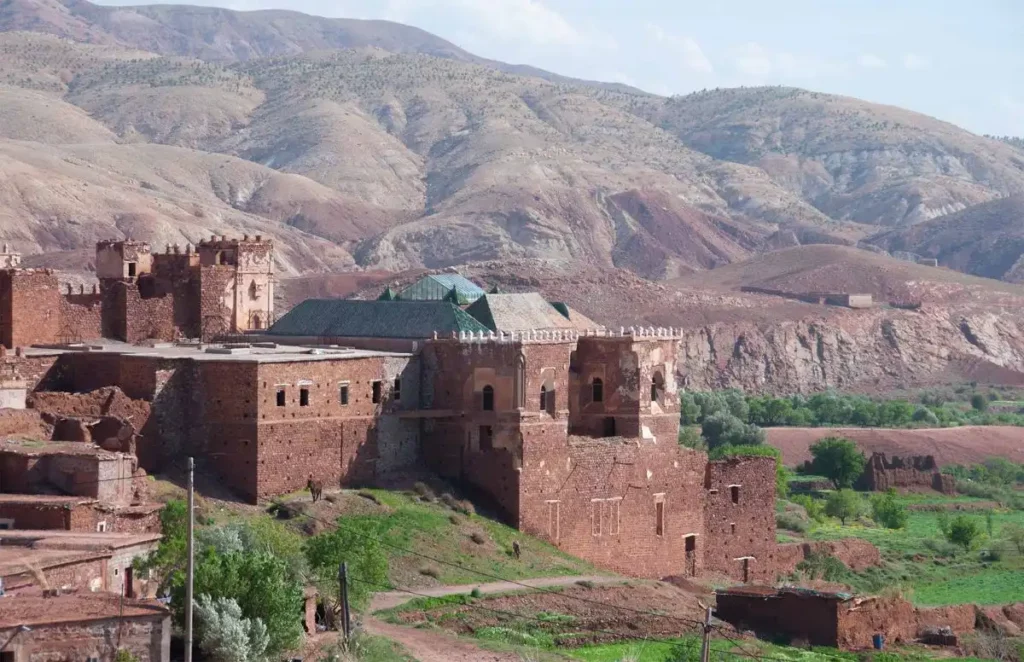
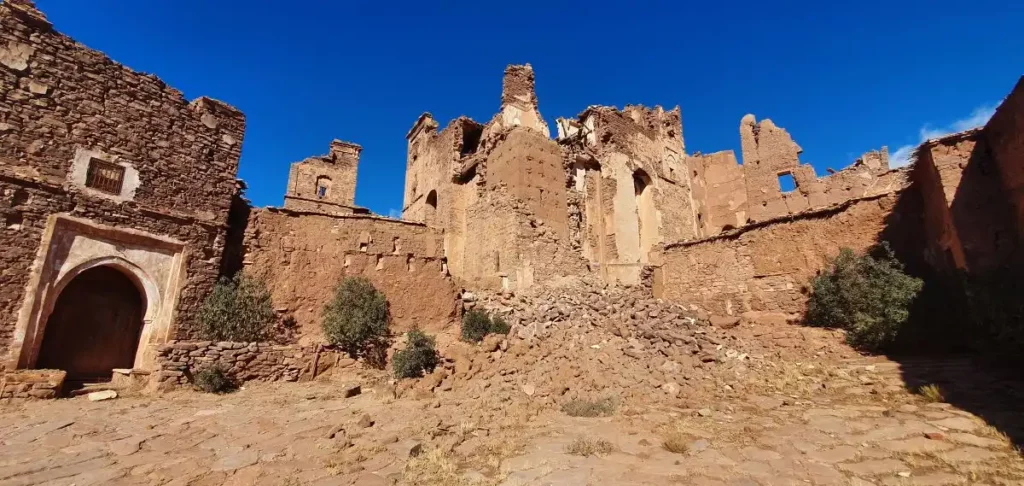
Telouet Kasbah does not reveal itself as immediately as Aït Ben Haddou. Its exterior appears confused, deeply damaged and at times almost absorbed by the ruins surrounding it. At first, visitors may feel that they have arrived too late, confronted by the remains of a monument apparently condemned to disappear.
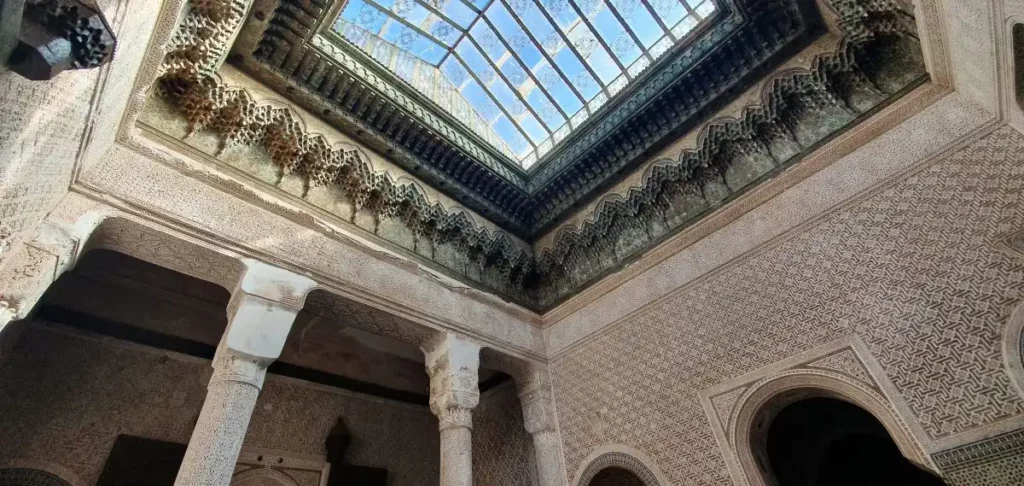
Yet the moment one enters the rooms that are still accessible, everything changes. Collapsed earthen walls give way to zellij, carved stucco, painted woodwork and the sophisticated compositions of a genuine palace. This sudden transition from ruin to refinement is one of the most striking experiences in the region.
But Telouet should not only be admired. It needs to be understood. The kasbah was the centre of a territorial, economic and military power that dominated part of Morocco before collapsing at the time of independence. Its walls therefore carry a history that is more ambiguous than glorious: a story of wealth, the violence of the caidal system, an alliance with the French Protectorate and the fragility of all forms of power.
Why visit Telouet kasbah ?
Discover one of southern Morocco’s most distinctive palaces
Telouet Kasbah was not built according to a single architectural plan. It developed through successive extensions constructed between the nineteenth century and the middle of the twentieth century around a number of earlier buildings. Construction of the main complex is generally thought to have begun in the 1860s, followed by several periods of expansion led by different members of the Glaoui family.
At its height, the complex served many different purposes. It contained the family residence, reception rooms, an administrative centre, a court, military quarters, stables, storerooms, servants’ accommodation and buildings intended for travellers and representatives of the authorities.
Telouet was therefore closer to a small palatial town than to the simple fortified residence that the word “kasbah” might suggest.
Observe the meeting of two architectural traditions
The oldest sections use the materials and architectural principles of the High Atlas: thick walls, stone, earth, defensive structures and towers overlooking the surrounding landscape.
The later palatial wings reflect a very different ambition. The Glaoui employed craftsmen capable of recreating the elaborate decoration of Morocco’s imperial palaces: geometric zellij, finely carved plasterwork, sculpted wooden doors, painted ceilings, columns, polylobed arches and muqarnas.
Architecture became a political language. The purpose was no longer simply to protect a residence, but to impress visitors and make the power of its owners visible.
Experience the contrast between splendour and ruin
Few monuments in Morocco offer such a powerful contrast. From the outside, the fractured structures, breached walls and weakened towers suggest a world that has collapsed. Inside, several rooms have preserved decoration of a quality comparable to that found in some of Marrakech’s finest palaces.
This coexistence of splendour and disappearance has become the defining character of Telouet. It should not, however, make us forget the extreme vulnerability of earthen architecture, further weakened by abandonment, severe weather and the earthquake of 2023.
Read also : Telouet: cradle and stronghold of the Lords of the Atlas
Understanding the history of the Glaoui family
Telouet, a strategic passage through the Atlas
Before the construction of the modern road over the Tizi n’Tichka Pass, the routes through Telouet formed one of the principal links between Marrakech and the pre-Saharan valleys. Caravans, the armies of the Makhzen, travellers and goods all crossed the Atlas through these mountain passages.
The presence of nearby salt deposits further increased the economic importance of the area. Control over the passes, markets, taxes and movement of goods contributed to the wealth of the local rulers.
Telouet was therefore not an isolated palace in the mountains. It stood at the centre of a network connecting Marrakech with the Drâa, Dadès, Todgha and Tafilalet valleys, as well as the old trans-Saharan trade routes.
The turning point of 1893
In the autumn of 1893, Sultan Hassan I was returning from a long expedition to the Tafilalet when a snowstorm brought his army to a standstill in the Telouet region. Madani El Glaoui mobilised the resources of his territory to shelter and supply the royal court and troops for several weeks.
This hospitality decisively strengthened his relationship with the central authorities. Hassan I granted him responsibility over extensive territories and supplied him with modern weapons, including the famous Krupp cannon now associated with the rise of Glaoui power.
The influence of the Glaoui did not emerge overnight. The events of 1893 nevertheless gave Madani the political and military means to expand his authority rapidly.
From Madani to Thami El Glaoui
Madani El Glaoui was the true architect of the family’s expansion. He became one of the leading dignitaries of the Makhzen and eventually served as Minister of War and then Grand Vizier under Moulay Abdelhafid.
His younger brother Thami continued this rise to power. Appointed Pasha of Marrakech, he became one of Morocco’s most powerful figures during the French Protectorate. He owned extensive land, controlled numerous economic activities and maintained close relationships with the colonial authorities and prominent foreign visitors.
This power, however, rested on an authoritarian system. The taxes, forced labour, imprisonment and military interventions imposed upon local populations should not be hidden behind the romantic expression “Lords of the Atlas”.
The fall of a world
During the early 1950s, Thami El Glaoui openly opposed Sultan Mohammed V and supported the manoeuvres that led to the sovereign’s exile in 1953. The Sultan’s triumphant return in November 1955 marked the definitive end of Glaoui power.
Thami El Glaoui submitted to the Sultan and died only a few weeks later, in January 1956. Telouet Kasbah was subsequently abandoned and looted before gradually falling into ruin.
Telouet thus became an almost perfect symbol of the disappearance of the caidal system: an immense and still sumptuously decorated palace, deprived of the power that had brought it into existence.
Read also : Once upon a time in the ksar of Aït Ben Haddou, four Christian princesses …
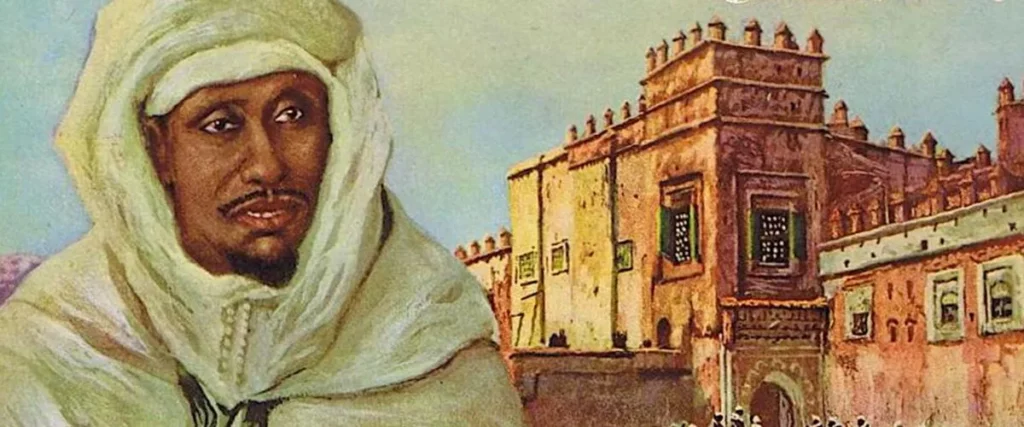
What to see at Telouet Kasbah
The walls and successive layers of the palace
Before entering, take time to observe the entire complex from the outside. The buildings do not present a single orderly façade. Towers, defensive walls, terraces and ruined wings overlap, reflecting the different periods of construction.
This apparent confusion helps visitors understand how the kasbah developed alongside the growing power of the family. Each generation enlarged, altered or embellished the residence.
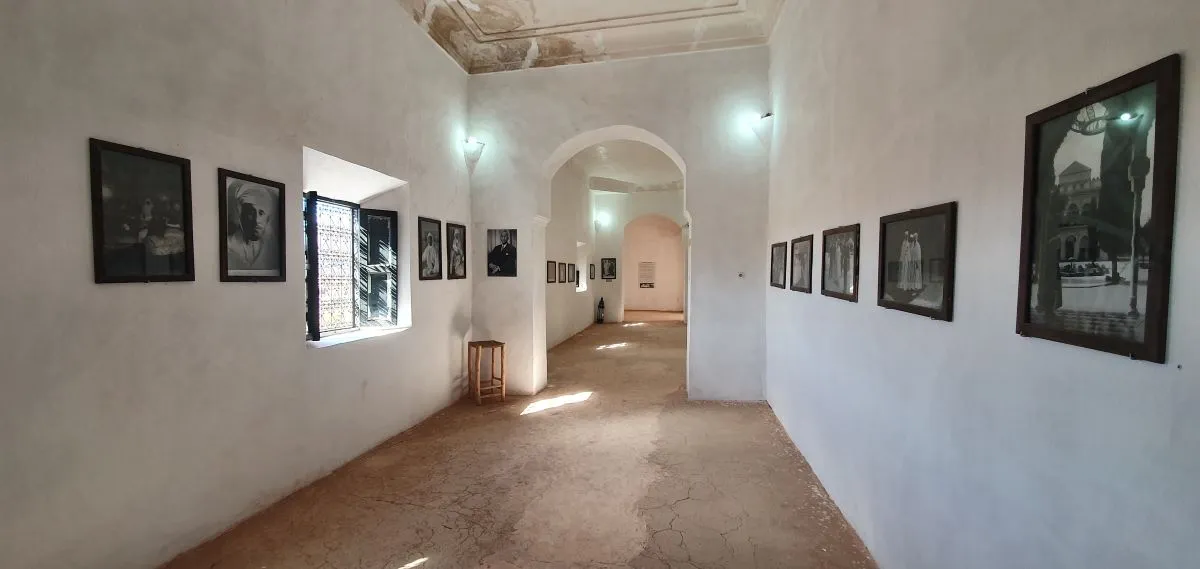
The reception rooms
The most remarkable spaces are the former ceremonial reception rooms. Their walls are covered with zellij, while the upper sections combine carved plasterwork, calligraphic inscriptions, plant motifs and geometric compositions.
The painted wooden ceilings, carved doors and precisely assembled floors demonstrate the skill of highly specialised craftsmen.
It is important to remember that the entire palace has not survived in this condition. The rooms currently accessible represent only a small part of the original complex.
Entrance to the kasbah is ticketed.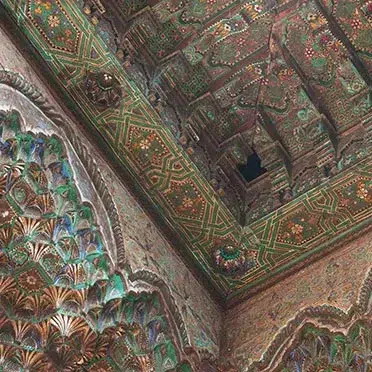
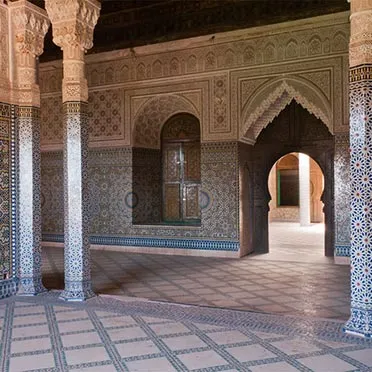
The courtyards and galleries
The inner courtyards connected the different parts of the residence and organised movement between private, administrative and ceremonial spaces.
The openings between the reception rooms now create striking perspectives. They also reveal how power was staged through architecture: a succession of doors, changing light and a gradual progression towards the most richly decorated spaces.
The ruined sections of the kasbah
Some areas have completely collapsed or remain closed to visitors. They should not be regarded simply as a picturesque backdrop. Earthen walls can weaken rapidly, and the damage caused by the earthquake is still clearly visible.
Remain within the authorised visitor routes and do not cross barriers or enter closed areas.
Read also : The palm grove of Skoura, the quintessential oasis
Read also : The lost destiny of Jews from South East Morocco
How to get to Telouet Kasbah
From Ouarzazate
The most rewarding route follows the road towards Aït Ben Haddou and then continues through the Ounila Valley. From Ouarzazate, take the road towards Marrakech before turning towards Aït Ben Haddou. Beyond the ksar, the P1506 climbs through the valley, passing Tamdakhte and Anmiter before reaching Telouet.
The journey covers approximately 76 kilometres, but deserves a full day. Earthen villages, cultivated terraces, rock formations and ancient fortifications are all an essential part of the experience.
From Marrakech
From Marrakech, follow the N9 towards the Tizi n’Tichka Pass and Ouarzazate. After crossing the pass, take the turning signposted for Telouet and the Ounila Valley.
Telouet can be visited as a stop before continuing towards Aït Ben Haddou and Ouarzazate. This alternative is slower than the direct main road, but considerably richer in terms of scenery and cultural heritage.
By public transport
Shared transport services are available, but they remain irregular and are not well suited to an excursion combining Telouet, the Ounila Valley and Aït Ben Haddou in a single day.
A car, a private taxi hired for the day or an excursion with a driver will offer much greater freedom. Road conditions should be checked in winter and after periods of heavy rain.
Where to stay in Telouet
Telouet has a small number of simple inns and guesthouses located in the village or its immediate surroundings. Staying overnight allows visitors to experience the kasbah and village after the day visitors have left, while also providing more time to explore the Ounila Valley.
Accommodation remains limited and availability may vary according to the season. Booking in advance is recommended, particularly in winter. Check whether heating is available and whether dinner can be provided at the property.
Travellers looking for a wider choice of accommodation can stay in Aït Ben Haddou or Ouarzazate and visit Telouet during a day trip through the Ounila Valley.
Looking for advice? Contact us
Beyond Telouet Kasbah
Travel through the Ounila Valley
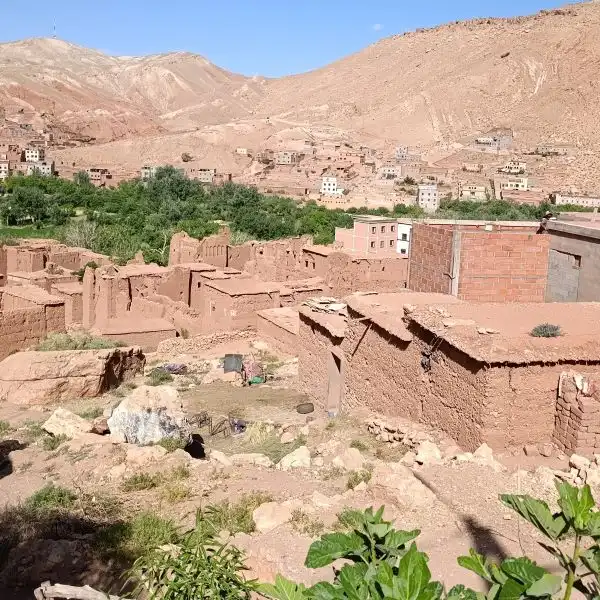
The Ounila Valley naturally connects Telouet with Aït Ben Haddou. The road passes through a mountain landscape gradually shaped by cultivated terraces, earthen villages and former Glaoui strongholds.
This is far more than a secondary road. It reveals the relationship between the High Atlas passes, the southern valleys and the old trade routes.
Visit Anmiter, the village painted by Jacques Majorelle
On the road between Telouet and Aït Ben Haddou, Anmiter is one of the most remarkable earthen villages in the Ounila Valley. Jacques Majorelle stayed there during his 1921 journey through the Glaoui territories and made the village one of the major subjects of his work. Its kasbahs, terraces and landscapes appear in several of his paintings, and some of the original viewpoints can still be recognised today.
The paintings created during this expedition were exhibited in Paris in 1922, and Majorelle later returned to the valley several times. The house in which he stayed also preserves small wall paintings attributed to him.
Anmiter reveals another side of Majorelle: not simply the creator of Marrakech’s famous garden, but a painter of earthen architecture and High Atlas landscapes.
Stop in Tamdakhte
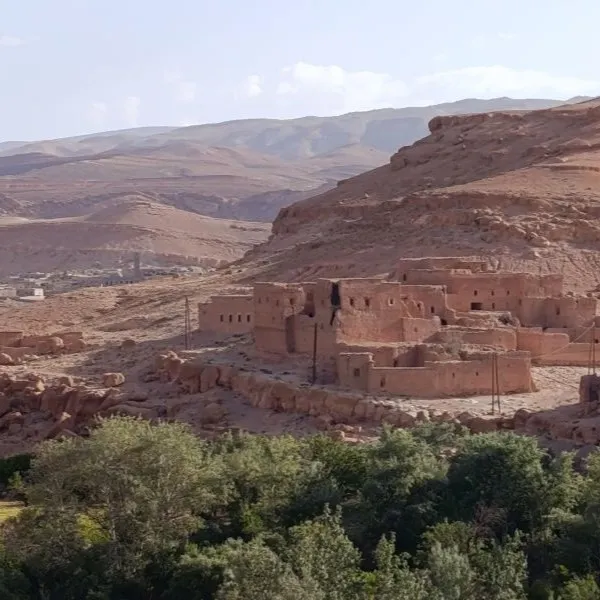
Tamdakhte was once an important fortified centre between Telouet and Aït Ben Haddou. Its history is closely connected with the expansion of Madani El Glaoui’s power at the end of the nineteenth century.
Its large earthen buildings, now partly ruined, extend the historical narrative of the valley and demonstrate that Glaoui power depended upon an entire network of kasbahs and command posts.
Continue to Aït Ben Haddou
Approximately 47 kilometres from Telouet, Aït Ben Haddou forms the natural continuation of the journey. The two sites complement one another particularly well:
- Telouet tells the story of the power exercised by a family of caids;
- Aït Ben Haddou reveals the organisation of a fortified community;
- the Ounila Valley connects the two monuments through both geography and history.
Telouet should therefore not be presented as a rival to Aït Ben Haddou, but as the second half of the same great heritage route.
For more informations : contact us
Planning a stay in Telout ? A question, need information?
Use the contact form — we will be happy to help.