M’Hamid El Ghizlane: at the threshold of the Sahara
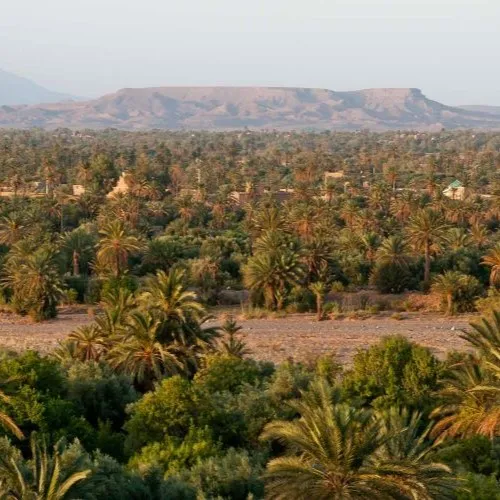
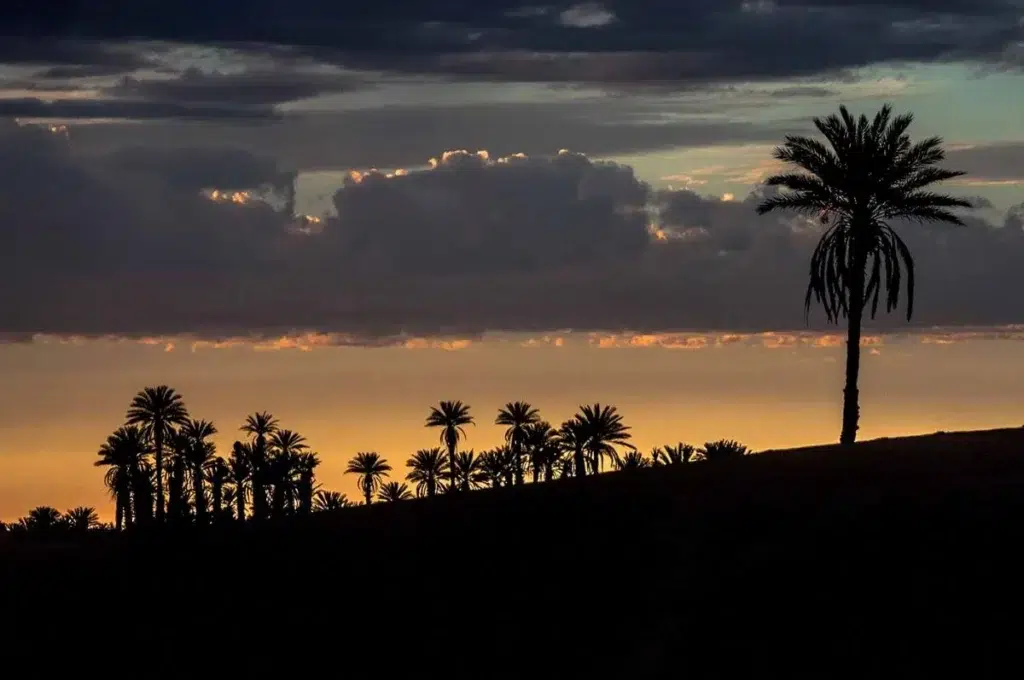
At the far end of the Drâa Valley, M’Hamid El Ghizlane marks the transition from the oasis world to the vast expanses of the Sahara. Its modern village, old ksour, increasingly fragile palm grove and first sand dunes form a landscape of transition, once crossed by caravans and now the main starting point for journeys towards Erg Chigaga.
The N9 road ends at M’Hamid after following the oasis settlements of the middle Drâa Valley. The village stands at an altitude of around 500 metres, in an environment that has become extremely arid. Recommended visit time: Half a day is enough to explore M’Hamid, its palm grove and some of its old settlements. Allow at least two days if you also wish to spend a night in the desert. Admission: access to the village and palm grove is free. Visits to certain houses or privately owned places may be subject to a small charge. Guide: a guide is not essential within M’Hamid itself, although local knowledge is useful when exploring the old ksour. A guide and experienced driver are essential for reaching Erg Chigaga or travelling along remote desert tracks. Best time to visit: from October to April. Outside the winter months, plan outdoor visits for the early morning or late afternoon.
M’Hamid El Ghizlane has neither the monumentality of Aït Ben Haddou nor the bustle of Zagora. Its modern centre, arranged along the main road, may even disappoint travellers expecting to encounter towering dunes and an immediately spectacular vision of the Sahara.
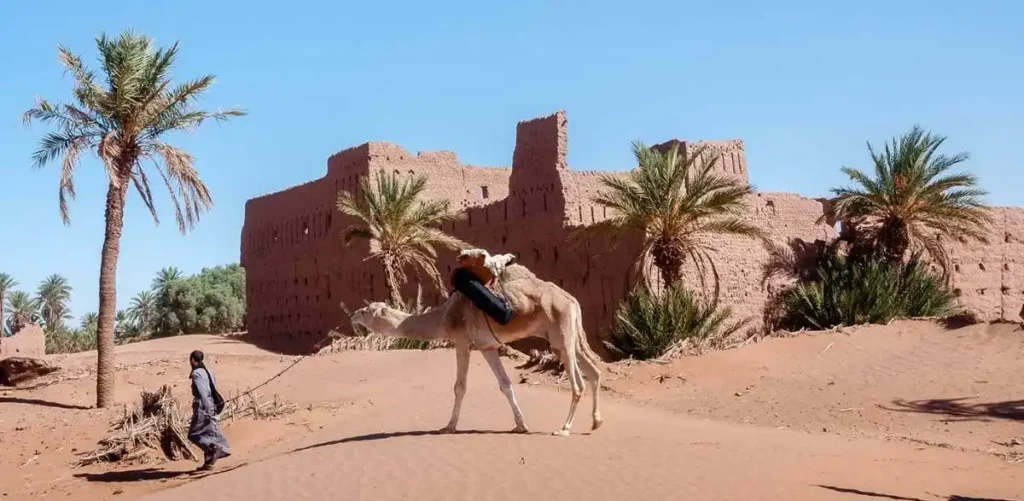
The place begins to reveal itself only when you stop treating M’Hamid as an isolated destination. Walk towards the old village, enter the palm grove, observe the houses gradually overtaken by sand and understand that you have reached the final meeting point between a cultivated valley and lands long travelled by nomadic communities.
M’Hamid is above all a place of passage. Yet it is precisely this transition — from road to track, oasis to desert and permanent settlement to travelled space — that gives it its true depth.
Why visit M’Hamid El Ghizlane?
Discover the last oasis of the Drâa Valley
M’Hamid stands at the southern end of the oasis system that stretches along the middle Drâa Valley.
From Agdz onwards, the Drâa runs through a succession of palm groves, cultivated gardens and earthen villages. At M’Hamid, this long ribbon of vegetation gradually comes to an end. The riverbed, usually dry at the surface, turns westwards, while cultivated land becomes scarcer and sand begins to spread between the palms.
M’Hamid is therefore more than a settlement built on the edge of the desert. It is the southernmost part of the middle Drâa oasis system, where irrigated agriculture has become particularly vulnerable to water scarcity, advancing sand and soil degradation.
This fragility is part of what visitors encounter. Isolated palm trees, abandoned plots and partially collapsed earthen walls are not merely picturesque features. They reveal the profound transformations affecting the oases of southern Morocco.
The name El Ghizlane comes from the Arabic al-ghizlān, the plural of ghazāl, meaning “gazelle”. M’Hamid El Ghizlane can therefore be understood as “M’Hamid of the Gazelles”, a name traditionally associated with the gazelles that once roamed the surrounding desert plains.
Understand a former caravan crossroads
Before motor vehicles replaced the great camel caravans, M’Hamid occupied a strategic position on the trans-Saharan routes.
People, animals and goods gathered here before continuing south across the Sahara or entering the Drâa Valley on their way to the markets of northern Morocco.
These routes connected Morocco with regions south of the Sahara, historically known as the Bilad al-Sudan. They carried goods, but also stories, languages, music and social practices. The cultural diversity of the oasis developed through encounters between oasis communities and Amazigh, Arab, Saharan and sub-Saharan populations.
The ruins of Ksebt El Allouj, commonly attributed to the Saadian period in the late 16th century, are associated with this period of trans-Saharan trade. Their exact function remains imperfectly documented, but the site recalls the historical importance of M’Hamid on the routes linking the Drâa Valley with the lands beyond the Sahara.
A landmark in Morocco’s modern history
M’Hamid also occupies a particular place in the modern history of Morocco.
On 25 February 1958, two years after independence, King Mohammed V met representatives of Saharan tribes in M’Hamid and delivered a speech concerning the country’s territorial unity and the future of its southern regions.
This event gave the remote oasis a political and symbolic importance far greater than its geographical size might suggest.
Read also : The Sahara, the mirror space of human adventure in Africa
Read also : Once upon a time in the ksar of Aït Ben Haddou, four Christian princesses …
What to do in M’Hamid El Ghizlane
Walk between M’Hamid Jdid and the old village
Walking from M’Hamid Jdid towards M’Hamid Bali is one of the best ways to understand the oasis beyond its modern roadside centre.
M’Hamid Jdid, the new village, contains most of the shops, cafés, accommodation and agencies organising desert excursions. To discover a different side of the settlement, leave the main road and walk towards M’Hamid Bali, the old village.
Its earthen buildings, narrow passages and gradually abandoned houses offer a glimpse of the oasis’s former organisation. Some areas remain inhabited or belong to local families, so visitors should remain discreet and respect private life.
The walk is particularly pleasant in the late afternoon, when the light brings out the texture of the earthen walls and temperatures begin to fall.
Explore the palm grove
The palm grove connects the oasis’s different settlements and old fortified villages.
Along its paths, you will encounter date palms, small cultivated plots, irrigation channels, tamarisk trees and areas already invaded by sand.
Walking through the palm grove helps visitors understand how a traditional oasis functions. It is not a naturally green landscape, but an environment created and maintained by generations of inhabitants, dependent on a delicate balance between water, crops, trees and human settlement.
A satellite-based study covering the period from 1984 to 2016 identified a marked long-term reduction in the vegetated area of the M’Hamid oasis. Drought, declining water availability, the abandonment of farmland, migration and certain forms of tourism development have all contributed to its transformation.
Explore the old ksour
Several old ksour — fortified earthen villages — are scattered across the wider M’Hamid oasis.
The area is not limited to M’Hamid Jdid and M’Hamid Bali. It also includes older settlements such as Bounou and Ouled Driss.
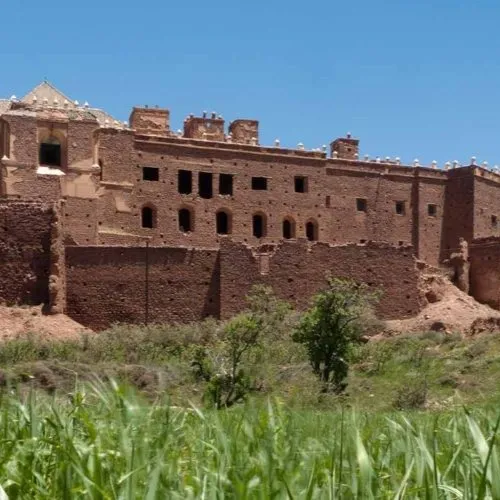
Their earthen houses, covered lanes and shared spaces reflect forms of architecture adapted to extreme heat, wind and the scarcity of building materials. Much of this heritage is now severely degraded, although local initiatives have attempted to restore buildings and maintain life within some of the old villages.
A local guide can help identify the different settlements, avoid entering private property and provide a clearer understanding of their history.
See the ruins of Ksebt El Allouj
Ksebt El Allouj is one of the main historical remains in the M’Hamid oasis.
Situated away from the modern centre, its ruins are generally dated to the Saadian period and associated with the control of caravan routes.
Do not expect a restored monument. Much of the earthen structure has collapsed, and the site has few visitor facilities. Its interest lies in its position, its earthen architecture and what it suggests about M’Hamid’s former role.
Because the remains are fragile and signage is limited, it is preferable to visit with a local resident or guide.
Reach the first dunes
You do not need to travel as far as Erg Chigaga to encounter your first sandy landscapes.
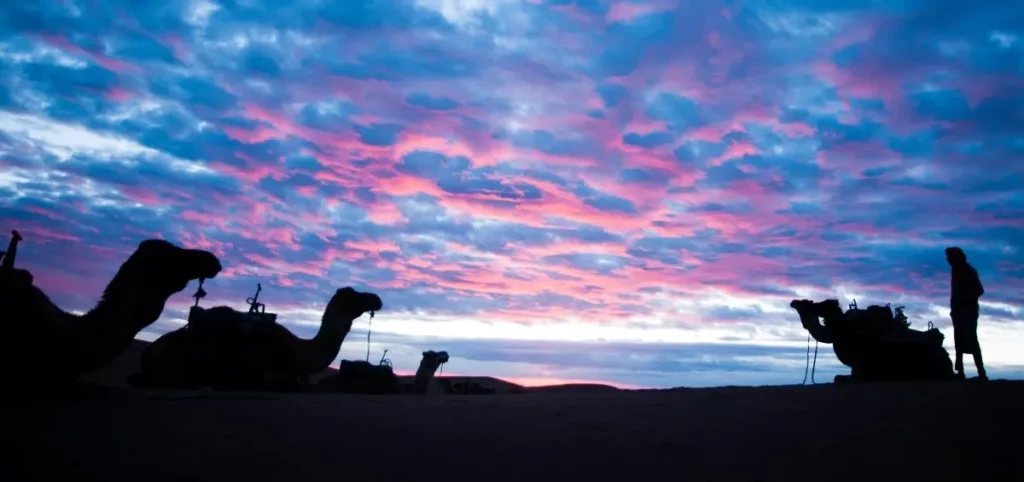
Small dunes lie around the edges of the oasis and can be reached on foot or during a short camel ride. They are especially beautiful at sunrise and sunset.
These dunes are modest in scale, but their proximity to palm trees and earthen houses creates a landscape characteristic of M’Hamid, suspended between oasis and desert.
They provide a rewarding introduction for travellers with limited time. They should not, however, be confused with the much larger dune systems found farther to the south-west.
Read also : The palm grove of Skoura, the quintessential oasis
Travel to Erg Chigaga
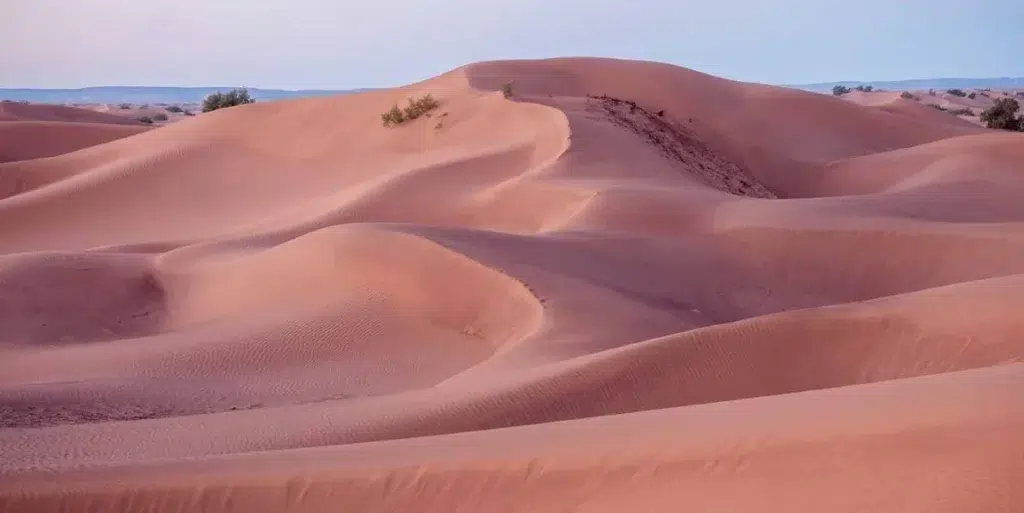
Erg Chigaga — also written Erg Chegaga — lies approximately 50 to 60 kilometres from M’Hamid.
There is no paved road to the dunes. The journey follows tracks across stony plains, sandy areas and a succession of desert landscapes.
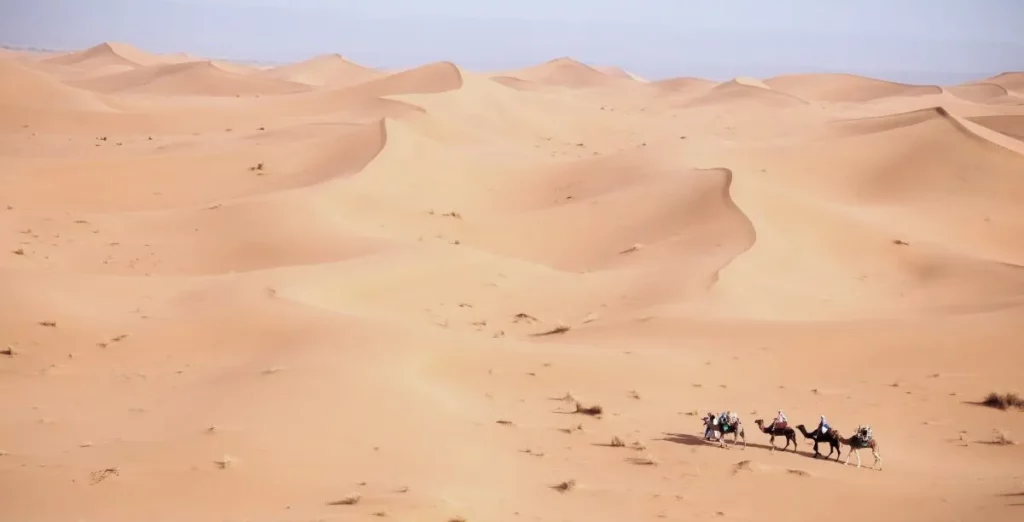
The trip usually takes between 1 hour 30 minutes and two hours in a four-wheel-drive vehicle, depending on the condition of the tracks and the location of the camp. It can also be undertaken over several days on foot or with a camel caravan.
Do not attempt this journey alone. Tracks can change, landmarks are scarce and mobile communications cannot always be relied upon. Travelling with an experienced local guide also helps avoid unnecessary and damaging vehicle movements through a particularly fragile environment.
A guide is essential.Spend a night in the desert
A night in the desert allows you to watch the sunset, experience the Saharan night sky and discover the extraordinary scale of its silence.
Several types of experience are available: a camp close to M’Hamid, a fixed camp in the surrounding desert or a more remote stay among the dunes of Erg Chigaga. The right choice depends on the time available and the level of comfort you require.
Before booking, ask how the camp manages water, waste and sanitation. A responsible desert camp should employ local guides and staff, limit unnecessary motorised journeys and leave the site clean after its guests have departed.
Looking for advice? Contact us
Read also : The oasis bears the seeds of tomorrow’s Morocco, and of the world
Experience nomadic cultures during the festivals
M’Hamid hosts several events devoted to Saharan and nomadic cultures.
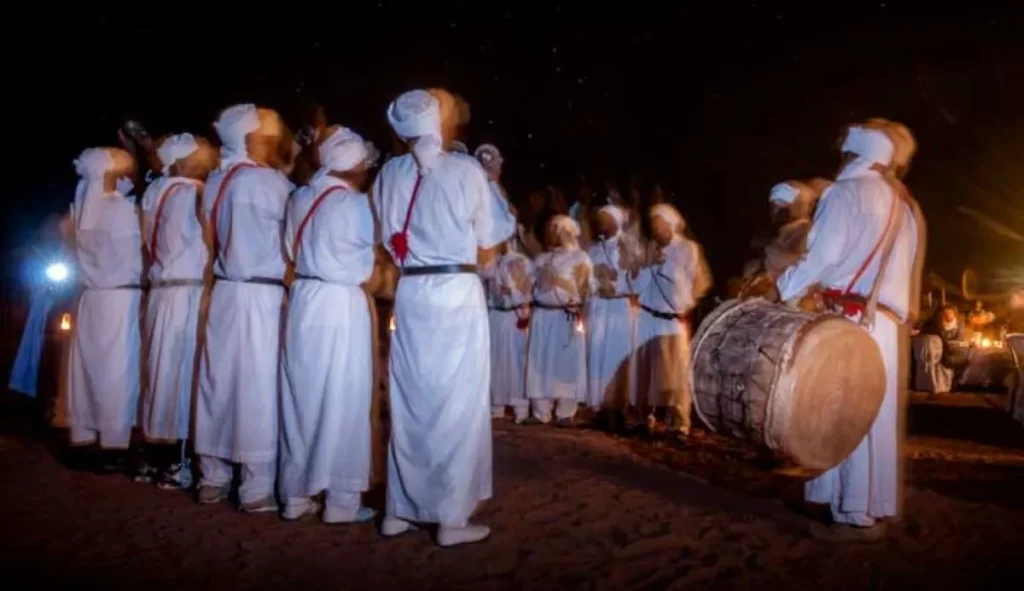
The International Nomads Festival brings together music, talks, crafts, oral traditions and activities connected with nomadic life. The Taragalte Festival, founded in 2009, combines concerts, poetry, cultural encounters and reflection on desert culture and the environment.
More recently, the Zamane Festival has highlighted the musical traditions of southern Morocco, the biodiversity of the oasis and initiatives led by local communities.
Festival dates change from year to year, so always consult the official programmes before planning your journey. The International Nomads Festival continues to be held annually in M’Hamid, while the third Zamane Festival took place in late 2024.
Read also : The lost destiny of Jews from South East Morocco
How do you get to M’Hamid El Ghizlane?
From Zagora
M’Hamid lies approximately 95 kilometres south of Zagora.
The N9 passes through Tamegroute, the Fezouata palm grove, Tagounite and the increasingly arid landscapes of the lower Drâa Valley.
The journey takes around 1 hour 30 minutes, although it would be a pity to make it without stopping. Tamegroute, the old ksour and the viewpoints over the valley all deserve some time.
Coaches, minibuses and shared grand taxis usually operate between Zagora and M’Hamid. As timetables can change, check locally before departure.
From Ouarzazate
M’Hamid is approximately 260 kilometres from Ouarzazate, representing nearly four hours of driving without stops.
From Agdz, the road follows the Drâa Valley, passes through Zagora and continues to its terminus at M’Hamid. It is a long journey, but one that reveals the gradual transformation of the region’s oasis landscapes.
For a more comfortable visit, plan an overnight stop in Agdz, Zagora or one of the valley’s palm groves rather than attempting a return journey from Ouarzazate in a single day.
From Marrakech
M’Hamid can be reached from Marrakech through the Tizi n’Tichka Pass, Ouarzazate, Agdz and Zagora.
The complete journey represents a very long day on the road. To experience the Drâa Valley properly, divide it over two days and plan at least one additional night in M’Hamid or the desert.
Getting around M’Hamid
The centre of M’Hamid and the nearby sections of the palm grove can easily be explored on foot.
A car, bicycle or local guide may be useful for reaching the older settlements scattered across the oasis.
Journeys beyond the oasis require a suitable vehicle and a driver familiar with the desert tracks. A four-wheel-drive vehicle is not a substitute for local knowledge, preparation or desert safety precautions.
Where to stay in M’Hamid El Ghizlane?
Staying overnight in M’Hamid allows you to enjoy the cooler morning temperatures, walk through the palm grove before the heat becomes intense and begin a desert excursion without first driving from Zagora.
The centre of M’Hamid Jdid offers the most practical options, close to shops, cafés and transport.
Accommodation around the palm grove, Bounou or Ouled Driss generally provides a quieter setting and a closer connection with the region’s earthen architecture.
A third option is to stay in a camp close to the oasis. This is suitable for a first desert experience or a short stay. To discover the larger dune landscapes, choose a more remote camp towards Erg Chigaga and allow at least two days for the excursion.
Looking for advice? Contact us
Beyond M’Hamid El Ghizlane
M’Hamid is the natural conclusion of a journey following the Drâa Valley southwards from Agdz and Zagora.
On the road back towards Zagora, Tamegroute deserves a stop for its zaouia, historic library and pottery workshops. The village maintains a long ceramic tradition, recognisable by its irregular shades of green glaze. Some workshops welcome visitors and may offer introductory sessions or longer courses.
The old villages of the valley, the ksar of Tissergate and the Zagora palm grove continue this exploration of oasis cultures.
In the opposite direction, the paved road ends at M’Hamid. Desert tracks lead towards Erg Chigaga, the landscapes around Iriqui and, on longer crossings, Foum Zguid. These routes must be organised with professionals who know the terrain.
M’Hamid should therefore not be seen merely as a departure point for a night under canvas. The village forms the final chapter of a valley shaped by water and agriculture, but also the first chapter of a world in which distances, movement and ways of life belong to a different geography.
For more informations : contact us
Planning a stay in M’Hamid El Ghizlane ? A question, need information?
Use the contact form — we will be happy to help.