Somewhere between January 12 and 14, an old woman still haunts the memory of Amazigh villages. They call her bayuza, the Old Woman of the cold — and her night carries a different name in nearly every valley of southeastern Morocco.
Since January 14, 2024, Yennayer has been a paid national holiday in Morocco, a recognition the Amazigh movement had sought for decades. But the ritual itself never waited for the state. In 1920, ethnographer Émile Laoust was already recording it, straight from the mouths of Chleuh women and elders, in Mots et choses berbères — still one of the most precise sources we have on these threshold rites.
Panorama
- Yennayer or Januarius: the roots of the name.
- Laoust’s forgotten chapter.
- The legend of the borrowed days.
- One night, a hundred names.
- The threshold table: tagulla, urkimen, and seven-vegetable couscous.
- Reading the year ahead: omens and divination.
- The last Wednesday and the rain forecasts.
- Yennayer today.
- Key takeaways.
- Editor’s note
Yennayer or Januarius: the roots of the name
The Amazigh New Year opens the agricultural year, not the civil one. It falls on January 14 in Morocco — sometimes the 12th or 13th elsewhere in the Maghreb — and has counted year 2974 of the Berber calendar since January 2024. The next threshold, in January 2027, opens year 2977.
A tradition popularized in the 20th century ties this count to the coronation of the Amazigh king Chachnak — Sheshonq I to Egyptian pharaohs — around 950 BCE. No archaeological evidence confirms it. The story still carries weight: it gives Yennayer an origin of its own, apart from any calendar imposed from outside.
Laoust’s forgotten chapter
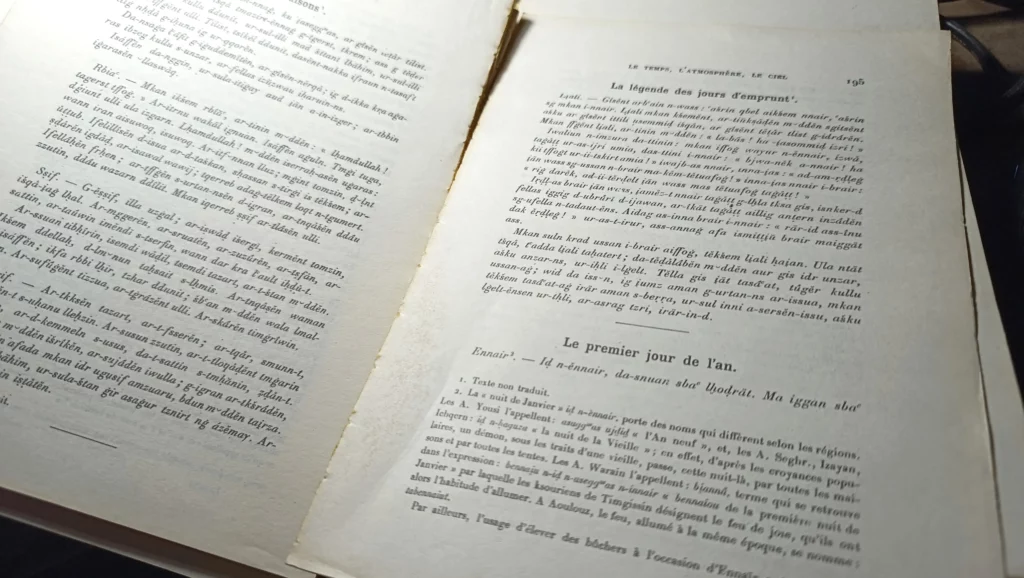
Émile Laoust spent part of his career crossing Chleuh-speaking Morocco, recording what modernity was about to erase, straight from the women and elders who still lived it. Mots et choses berbères, published in 1920, remains one of the most meticulous surveys of that world.
Chapter VI, on time, weather, and sky, gives six precise pages — 195 to 201 — to the first day of the year. It holds a legend translated nowhere else, night-names that shift from valley to valley, household omens that general-press coverage of Yennayer almost never mentions.
The legend of the borrowed days
Before Yennayer come the liali — some forty dreaded nights when the cold settles into the mountains and herders fear losing their flocks. It’s in that tense climate that Laoust records, in untranslated Chleuh, the legend of the borrowed days.
As his reign nears its end, Ennayer — January, personified — swears he has harmed no one all winter. An old woman scoffs: she and her flock survived him easily, she says. Stung, Ennayer turns to Brayer, February, and borrows a day.
With that stolen day, he unleashes hail and freezing wind on the old woman’s flock, driving it to the mountaintop. Brayer asks for his day back. Ennayer never returns it — which is why, the elders say, February counts one day short of every other month.
The same motif — a month that borrows to punish — turns up elsewhere across the Maghreb in different shapes; “days of the old woman” are documented from the Sahara to the Mediterranean coast. The version Laoust fixed on paper belongs to Chleuh country alone: one day, one debt, never settled.
One night, a hundred names
Reading Laoust valley by valley, what stands out most is how many names this one night carries. The Aït Yousi call it asuggwas ujdid, “the new year.” The Aït Seghrouchen, the Izayane, and the Ichqern call it id n-bayuza, “the night of the Old Woman” — a demon wearing an old woman’s face, they believe, who passes through every house and every tent that night. The Aït Ouarain call it biannou, a word that survives in place names too: Tabennaiut, the mountain overlooking present-day Khénifra, still carries its trace.
The bonfire lit for the occasion, called bennaiu or tabennaiut depending on the tribe, isn’t unique to Yennayer alone. The Muslim feast of Achoura, which also marks a new beginning, absorbed part of the same ritual — so thoroughly that in Ouargla, the same word names Achoura itself. The two celebrations blurred together over time, and even the Chleuh who still sing these words no longer always know what they once meant.
At nightfall, Aït Isaffen children go door to door singing: “Bennayo! Bennayo! Whoever won’t give me my dumpling and my bone, may their dog drag them and churn their butter in a packsaddle!” Further south, in the Dadès valley, children chant Bayanno, kerkano; in Demnat, among the Infedouaq, they ask for the “bones of Baino.” Three valleys, three refrains — the same threshold of the year, crossed each time in song.
The threshold table: tagulla, urkimen, and seven-vegetable couscous
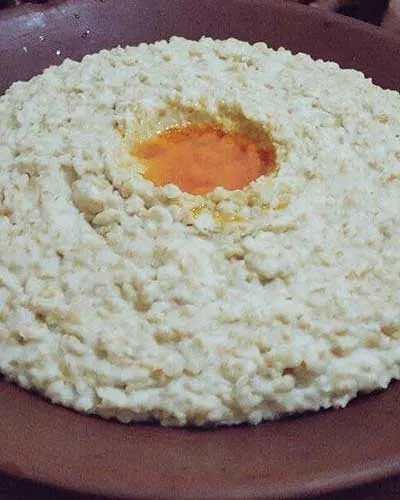
The Yennayer ritual, Laoust notes, comes down in Chleuh country to a hearty meal followed by forecasts for the year ahead. Families eat tagulla, a thick porridge still known today as Tagoula and believed to fortify the body, or coarse-grain couscous, berkuks.
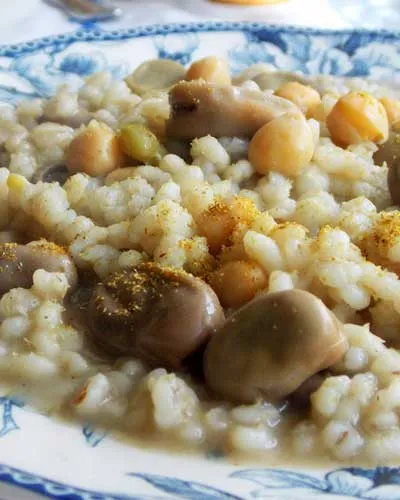
The seven green vegetables served alongside — among them artichoke, wild asparagus, and watercress — give the dish its name, sb’a lehodrat. Urkimen, a mix of grains cooked with the trotters of the animal slaughtered at Eid al-Adha, symbolically closes the ritual cycle of the year just past. Among the Aït Tamemt, custom calls for two whole chickens per person — “as many as one has ears,” the text notes, not without a smile.
Eating one’s fill that night is no small matter: “whoever isn’t full that day won’t be full all year,” runs a saying Laoust recorded among the Ida Oukensous. The second night belongs to eggs and poultry; everyone keeps the eggshells knotted in a fold of clothing overnight, a charm against running short of money before the year is out.
Reading the year ahead: omens and divination
After the meal, among the Ntifa, a woman of the house rolls a handful of couscous into a dumpling and offers it to each family member in turn. She then sets it above the doorframe; by morning she reads it for omens in whatever hair, wool, or feather the night wind has left there — the talkimt n-djiuneg, “the dumpling of I’m-not-hungry-anymore.”
Other omens hide in the food itself. Among the Aït Mzal, a small coin, a date pit, and a piece of argan bark go into the cooking pot: finding the coin means wealth, the bark means poverty, the pit means a growing herd. Laoust himself likens the custom to the French Twelfth Night cake — a hidden token, a fortune drawn by chance, two worlds that never met yet answer each other.
Yennayer is also the night the hearth gets renewed. The lady of the house tosses the worn stones onto the dungheap, saying: “I exchange you, O stones… for peace and prosperity.” Afterward, men and women go listening at neighbors’ doors, reading whatever conversation they overhear as an omen for the year — in Timgissin, a girl hoping to marry does the same while licking the spoon that stirred the porridge.
The last Wednesday and the rain forecasts
Among the Ida Gounidif, the month’s last Wednesday calls for a ritual urkimen in which every ingredient — lentils, turnips, carob bark — carries its own meaning, in a ceremony Laoust details over several pages. It deserves a fragment of its own one day.
Among the Ihahan, three tagulla dumplings stand in for January, February, and March, set out on the terrace and sprinkled with salt. Whichever one dissolves overnight marks, by morning, the wettest month to come — a home-grown forecast, kept every year without instrument or almanac.
Yennayer today
Since May 2023, by royal decision, the Amazigh New Year has been a paid national holiday — an institutional recognition long sought by the Amazigh movement, and hailed as acknowledgment of a pillar of Moroccan identity alongside the Hijri and Gregorian calendars. Algeria and Libya had already granted it that status.
Laoust already sensed it in 1920: Yennayer’s practices fade as the countryside empties out. Today the Royal Institute of Amazigh Culture runs conferences and concerts to keep the memory alive — an institutional gesture that can’t quite replace a dumpling hung on a Chleuh doorway, read at dawn by a woman who has never heard of Laoust.
Read also : Our ancestors, the Berbers…
Read also : The Berber world
Key takeaways
- Yennayer has been a paid national holiday in Morocco since January 14, 2024, marking the start of the Amazigh agricultural year — year 2977 opens in January 2027.
- The name comes from the Latin Januarius; its link to King Chachnak (Sheshonq I, c. 950 BCE) remains a tradition, not an archaeologically proven fact.
- Émile Laoust devotes six precise pages of Mots et choses berbères (1920, ch. VI, pp. 195-201) to the ritual, including a never-translated legend of the “borrowed days.”
- Yennayer’s night changes name by tribe — asuggwas ujdid, id n-bayuza, biannou — and blends in places with the Achoura ritual.
- The night’s omens — the hung dumpling, the hidden coin, the listening at doors — all aim at the same thing: reading the year’s fortune in its first small gestures.
Editor’s note
We grew up thinking Yennayer came down to one dish and one date. Laoust’s chapter says otherwise: an old woman taunting winter, a stolen day never returned, a dumpling read at dawn like an oracle.
What stays with us, closing the book, is precision rather than grandeur. Renewing the hearth stones, listening at doors, knotting eggshells into a fold of cloth: nothing spectacular, just a whole craft of starting the year with what’s close at hand.
A century after Laoust, some of that knowledge still lives in the memory of a few elders across southeastern Morocco. The rest, never written down, went with them — and, like Brayer’s day, was never given back.
Sources
- Émile Laoust, Mots et choses berbères. Notes de linguistique et d’ethnographie, dialectes du Maroc, Challamel, 1920, chapitre VI « Le temps, l’atmosphère, le ciel », p. 181-201.
- Le360, Officiel : elle comprend désormais le Nouvel An amazigh, novembre 2023.
- Jeune Afrique, Au Maroc, Yennayer célébré pour la première fois lors d’un jour férié, janvier 2024.
- Middle East Eye, Maroc : le Nouvel An amazigh désormais jour férié officiel, 2023.