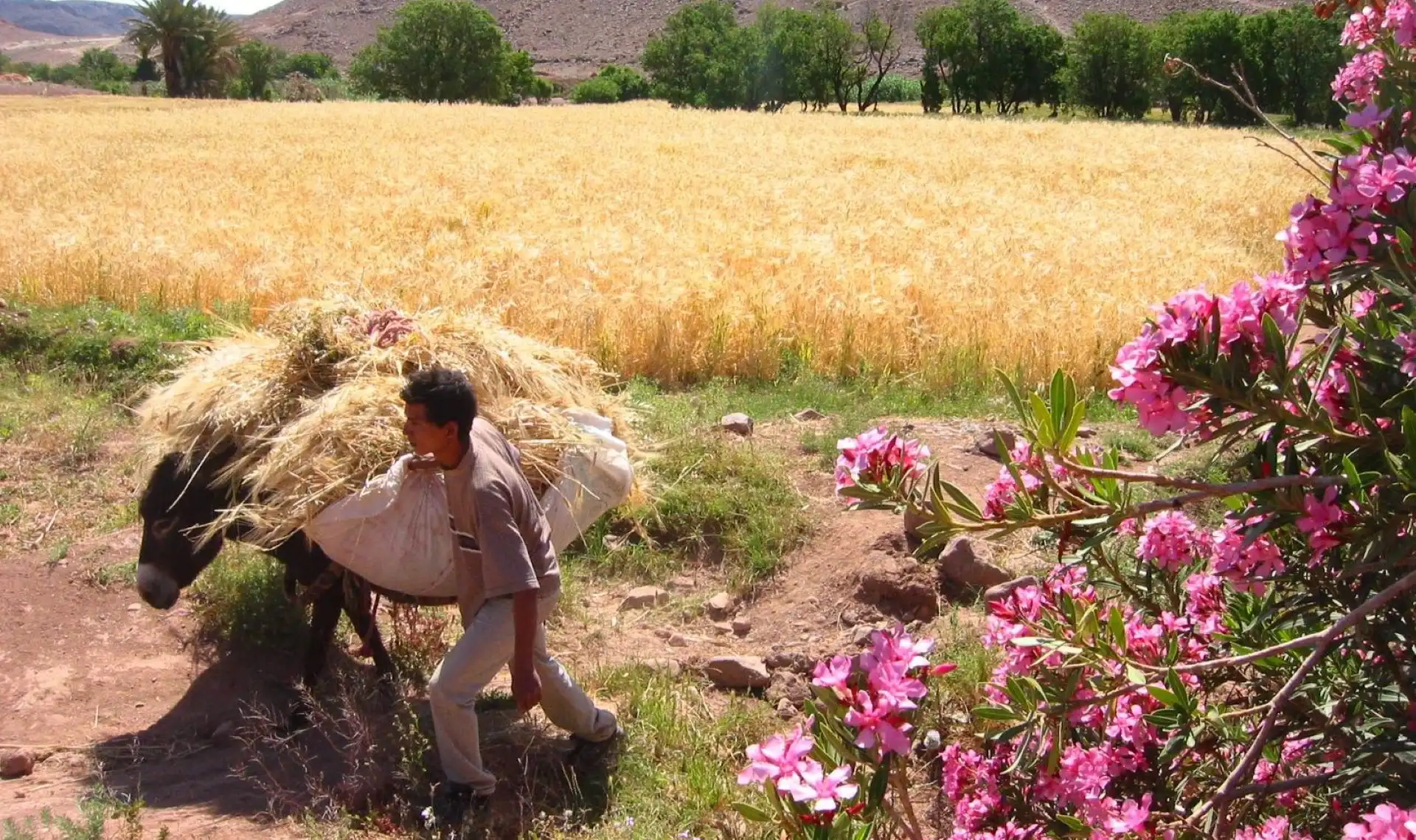
A man walks toward the last standing ears of wheat. Since morning he has worn the title of King — but in the wheat fields of central Morocco, to be King is already to be marked for death. Around him, his harvesters hold their breath: in a moment, they will seize him.
Panorama
- The King and his son.
- The braid of the field.
- The capture of the King.
- Mut, mut, ia-feddan! — The funeral formula.
- The soul of the field.
- The Bride of the field.
- The harvest sacrifice.
- The bridge to Anzar.
- Emile Laoust’s own perspective.
Laoust records these practices before they fade. Some have since vanished; others may have survived in weakened or altered form. What follows is, first, a dated testimony — the record of a researcher who took care to write down, tribe by tribe, formula by formula, what his informants told him.
The King and his son
Among the Mtougga, the harvest opens like a small court ceremony. Before any work begins, the farmer and his workers share a meal of bread and butter in the field. Then, tying on leather aprons, they line up at the edge of the wheat, sickles in hand.
The first in line carries, for the day, the title of agellid — the King. Behind him stands his son, his khalifa, literally his deputy, “successor to the dignity of king.” Then come the ait tozzoml, the “people of the middle,” the bulk of the team.
Last comes tikrut, “the ewe lamb” — the least skilled harvester, the one who struggles to keep pace. This hierarchy is no mere pageant. For one day, it recreates an agrarian kingship, one already marked for a very particular fate.
This team is not always the farmer’s household alone. Many fields are harvested through tiwizi — the collective aid by which a village or clan lends a hand to whoever cannot finish the work alone. At Tanant, the harvest tiwizi closes with a scene still remembered: the farmer’s wife and daughters, dressed for celebration, greet the workers by waving a banner — a scarf tied to a reed — to “dry their sweat.” Laoust reads it differently: originally, he suggests, the gesture served to witness the field’s death and hasten the rain that would bring it back to life. The word tiwizi deserves more than a mention — we give it its own piece.
Read also : Our ancestors, the Berbers…
The braid of the field
The King has the honor of cutting the first sheaf, carried straight to the farmhouse. He then enters the wheat and marks out the nira, the strip his men will harvest behind him.
One rule holds firm: at the center of the field, a large tuft of ears must stay standing. Different tribes give it different names — tagottit n-iger or takiwt n-iger, the “braid of the field.” The Aït Yousi call it the tail, tabzzâl n-iger; the Zemmour, the curl, launza n-iger; the Tlit, the mane, izig n-iger.
The name shifts from valley to valley; the function never does. This tuft is no oversight by a hurried harvester. It is a deliberate reserve — a place where the community chooses not to cut, not yet.
The capture of the King
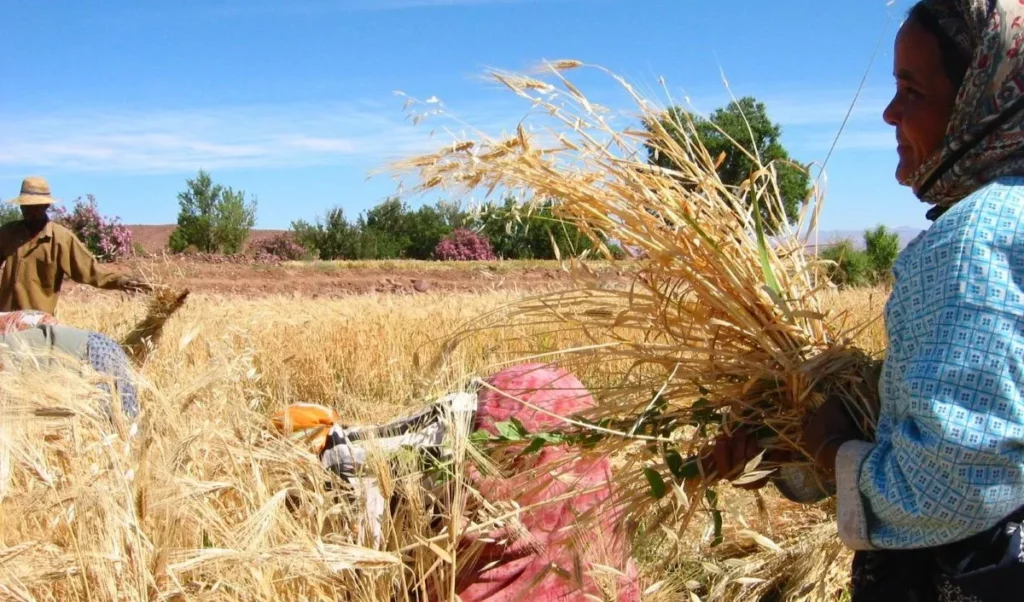
The work presses on. As the end nears, a competitive energy grips the harvesters, who suddenly race each other. Soon only one sheaf remains, at the field’s edge.
The King steps toward it to cut it. But the moment he raises his sickle, his own men seize him, bind him with a turban, and drag him to the mosque, where the village waits. A striking silence greets his arrival.
Laoust reads the scene in three stages. By cutting the last sheaf, the field’s master comes to embody the spirit of the grain it holds. Once, it is believed, this ritual killing had to happen in earnest, for the crop to grow again. The hushed negotiation between the King and the taleb, inside a sacred place, may be its distant echo.
The King wins back his freedom only through ransom — honey, butter, slaughtered sheep, served as a feast for the whole village. The harvest closes with a banquet Laoust describes, plainly, as sacred in character.
Mut, mut, ia-feddan! — The funeral formula
Across much of Berber Morocco, mourning language accompanies the cutting of the last ears. At Tanant, one harvester cries out:
“Recite the shahada — the field is about to die!”
Among the Imeghran, harvesters say as they cut the last sheaf:
“mut, mut a-feddân-nnag! gâder mulâna ihaik!” “Die, die, O our field! Our Master can bring you back to life!”
The Aït Tatla repeat almost the same words. In the Rif, the formula shifts slightly:
“mut, mut ai-feddân! asegg’as-iïd id ig’an athaiil!” “Die, die, O Field — next year you will return!”
Among the Izenaguen, harvesters cross their arms behind their backs and call out together:
“The same again, next year!” The Aït Yousi answer each other in two voices: one announces the field’s death, the other replies, “Glory to the One who never dies!”
Every tribe has its own words. At heart, they all say the same thing. The field’s death is only ever a stage.
The soul of the field
Earlier in his book, in the chapter on plowing, Laoust had already dropped a key line:
“The Berber lends a soul to his field”
Emile Laoust – Mots et choses berbères
— a soul he describes as
“that mysterious force through which crops rise up from the depths of the soil.”
Emile Laoust – Mots et choses berbères
He added, almost as a warning to the reader, that he would return to the idea in the very chapter on the harvest we have just walked through. The thread, then, is Laoust’s own; we have only followed it.
This link is already at work during sowing. Among the same Mtougga, a goat is slaughtered in the field; its blood, Laoust writes, can “embody the baraka of the field or the spirit of the grain,” given back to the earth so the field’s life continues.
Laoust goes further still, raising a more unsettling question: what if the field’s master, before he was merely bound in jest, was once the real victim of such a sacrifice? The question stays open. But it places the Harvest King within a family well known to mythologists — kings whose ritual death is now staged, and may once have been carried out in earnest.
The Bride of the field
In some regions, the central tuft changes sex. It is no longer the braid but laslit n-iger, the Bride of the field — or ‘arost n-iferddan among the Hiaina.
There, the farmer’s wife herself, dressed for celebration, cuts this final tuft. She throws its ears into the air, over the workers, calling out: “For the love of God!” The women around her answer with ululations and a song in memory of Sidi Ali.
Elsewhere, it is the village’s poor women, the limldrin, who pull the Bride free by hand, ear by ear — never with the sickle. Iron must not touch this sacred body.
The spirit of the grain thus wears two faces, depending on the place: an animal’s — mane, tail — or a young bride’s, promised, like the King, to a death followed by marriage to next year’s harvest.
The harvest sacrifice
Sometimes the spirit of the wheat takes an altogether different body: an animal, led to slaughter. Laoust calls this ceremony tigersi n-lmgra, the Harvest Sacrifice.
At Douzrou, among the Ida Oukensous, the farmer leads a young white heifer into his field, its back draped in pale cloth. He walks it three times around the braid, then cuts its throat in a cleared space among the last standing ears.
The blood flows into a hole, covered first with ashes from the Ashura fire, then with earth — so that no dog, it is said, can defile blood that has turned sacred. Each participant leaves with a fragment of the white cloth, kept afterward as a remedy against illness.
Elsewhere it is a sheep (Achtouken, Ida Ou Zekri), a cow (Imejjat), or a she-camel chased on horseback to exhaustion before being killed (Ida Ou Brahim). The principle stays the same throughout: give back to the earth, in blood and shared flesh, the strength just taken from it in grain.
The bridge to Anzar
Once the field has died, it must be reborn. Laoust concludes this chapter with the following observation:
“it is toward Anzar, the personification of Rain […] and husband of Tigonja, the personification of young, virgin Earth, that the faithful’s prayers now rise.”
Emile Laous – Mots et choses berbères
The myth of the dying wheat thus meets the myth of the rain. Laoust’s two chapters answer each other: the harvest calls the rain, as winter calls the spring.
Emile Laoust’s own perspective
Laoust does not hide his interpretive sources. In a footnote, he credits “the ideas of Mannhardt and those of Frazer in his Golden Bough,” and also cites Westermarck, praising his “fine study” of Moroccan agrarian ceremonies.
He goes as far as linking these southern Moroccan rites to “a myth dear to the classical Orient: the death and resurrection of a deity presiding over growth.” He is thinking, quite plainly, of Demeter and Proserpine — the Mother and the Daughter, Greek goddesses of wheat.
He reaches back further still, to ancient Egypt. Diodorus Siculus had already recorded how Egyptian harvesters, on cutting their first sheaf, mourned around it while invoking Isis — convinced that, in doing so, they had killed the field.
On this parallel Laoust closes his own chapter, in a line worth more than any commentary:
“the peasant of the Nile mourned around the first sheaf cut, invoking Isis; the Berber carries on the same lament, invoking Allah. Only a name has changed.”
Emile Laoust – Mots et choses berbères
He was a researcher of his era, with all the limits of that era. But his comparative instinct, sitting at the very heart of the text, opens a door we have only had to push.
Read also : The Berber world
Read also : Rites and legends of Yennayer, the Berber New Year
Key takeaways
- Among the Mtougga and several tribes of central Morocco, the harvest follows a ritual hierarchy: the King (agellid), his son (khalifa), the harvesters, and the “ewe lamb” (tikrut).
- Some harvests were carried out through tiwizi, collective village aid — a practice Laoust documents both as genuine solidarity and, at times, as feudal exploitation.
- The last tuft of ears, left standing at the center of the field, is called the braid, the mane, the tail, or the Bride of the field, depending on the region.
- Harvesters ritually capture the King; his release comes only through ransom, and the harvest closes with a sacred feast. Funeral formulas (“Die, die, O field!”) accompany the cutting of the last ears across Berber Morocco.
- The spirit of the grain can also take animal form — a sheep, a white heifer, a she-camel — sacrificed as part of the tigersi n-lmgra.
- Emile Laoust himself links this myth to Demeter and Proserpine, citing Mannhardt and Frazer as his interpretive framework.
Sources
- Emile Laoust, *Berber Words and Things*, Chapter VIII, ‘Harvest Rites’, pp. 370–386 approximately, supplemented by Chapter VII, pp. 318–328, regarding the spirit of the field and the tiwizi.