Carved into stone, preserved by the Tuareg, brought back into Morocco’s public space and now present in the digital world, Tifinagh is more than an alphabet. It is one of the most visible signs of Amazigh continuity through time. Drawing on an interview with Ahmed Skounti, anthropologist, heritage specialist and professor at the National Institute of Archaeology and Heritage Sciences in Rabat, this article looks back at a long, complex and still open history.
Panorama
- Understanding what Tifinagh means.
- Connecting Tifinagh to Libyco-Berber scripts.
- Placing its history within the wider Amazigh world.
- Exploring the debate around its origins.
- Understanding its contemporary revival in Morocco.
- Discovering its uses beyond Morocco today.
- Thinking about its future between identity, education and the digital age.
An alphabet between history and symbol
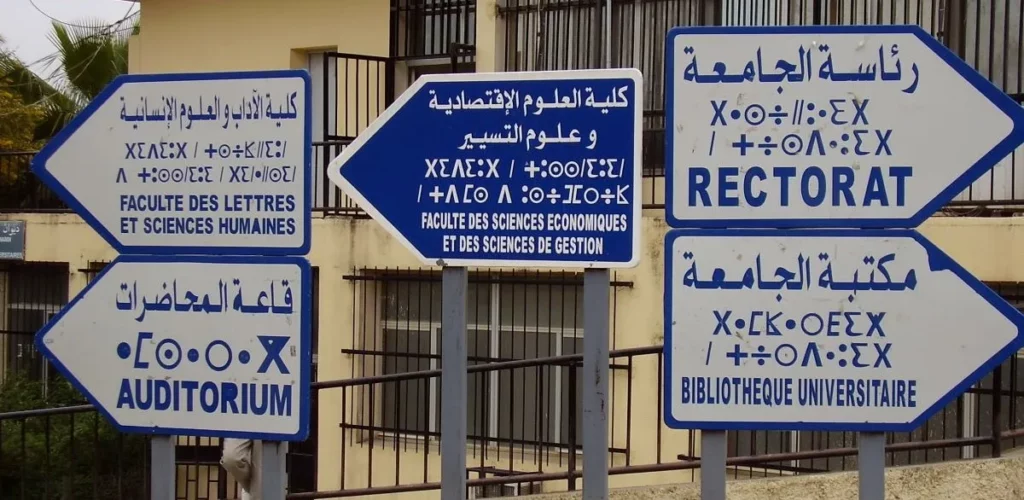
Today, Tifinagh is immediately recognisable. It can be seen on road signs, institutional façades, schoolbooks, cultural posters, logos, jewellery and contemporary graphic design. In Morocco, it has entered public space with renewed force since the early 2000s. But this recent visibility should not be misleading. Tifinagh is not a modern invention. Its current standardised form belongs to our time, but its roots reach back into a much older graphic tradition.
This deeper history is illuminated by the interview granted to sudestmaroc.com by Ahmed Skounti. An anthropologist, professor at the National Institute of Archaeology and Heritage Sciences in Rabat, a specialist in cultural heritage and familiar with research on rock art, Ahmed Skounti approaches Tifinagh with a double requirement: to recognise its symbolic power, while refusing simplification.
Tifinagh fascinates because it seems to offer a direct thread between Amazigh origins and the present. But that thread is neither simple, nor continuous, nor fully deciphered. It runs through ruptures, variations, forgotten uses, Tuareg continuities, cultural reappropriations, institutional choices and contemporary challenges.
Tifinagh, Libyque, Libyco-Berber: several names for a complex history
In everyday language, Tifinagh is often described as “the Amazigh alphabet”. The phrase is useful because it says the essential thing: Tifinagh is used today to write Tamazight, or more broadly Amazigh languages. But when one enters the longer history of the script, the words become more delicate.
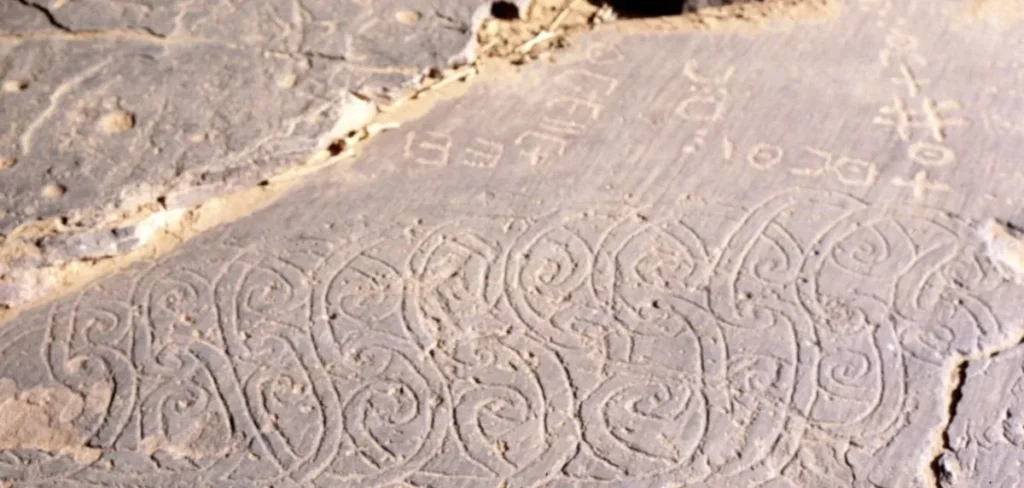
Scholars have long used the term “Libyque” to refer to ancient inscriptions found in the northern part of North Africa, particularly in antique contexts. The expression “Libyco-Berber” is also used for signs associated with rock engravings and paintings in Saharan and pre-Saharan areas. The word “Tifinagh”, meanwhile, has been more specifically linked to scripts preserved in the Tuareg world.
Ahmed Skounti insists on this point: we should not imagine a brutal transition between a Libyque alphabet that would have disappeared and a Tifinagh script that would then have appeared as something entirely different. Libyque and Tifinagh can rather be understood as variants of the same graphic foundation, differentiated according to periods, regions and uses.
This distinction is essential. It avoids two opposite mistakes.
The first would be to reduce modern Tifinagh to a recent political symbol with no historical depth. The second would be to project contemporary Tifinagh uncritically onto all ancient inscriptions, as if signs carved more than two thousand years ago could be read directly through the eyes of today.
Tifinagh is both continuity and transformation. It refers to an ancient memory, but it has also known losses, displacements, reinventions and modern codifications.
Read also : The Tifinagh, the Berber singularity engraved in time
A geography that extends far beyond Morocco
One of the major contributions of Ahmed Skounti’s interview is to remind us that Tifinagh cannot be confined to the Moroccan frame alone.
The history of this script concerns an immense space. Libyque or Libyco-Berber inscriptions have been identified across a vast territory stretching from the Mediterranean to Saharan and sub-Saharan fringes, from the Canary Islands to Libya, and as far as southern Niger. This breadth gives Tifinagh a pan-Amazigh dimension.
It therefore corresponds to the historical reality of the Amazigh world itself. Amazigh languages and cultures do not stop at modern borders. They cross Morocco, Algeria, Tunisia, Libya and Saharan Egypt, as well as Tuareg spaces in Mali, Niger and Mauritania.
To speak of Tifinagh from Morocco does not mean making it a Moroccan subject. Morocco has played an important role in its contemporary recognition, but Tifinagh reaches far beyond Morocco. It belongs to a broader North African and Saharan history, where ancient Numidian kingdoms, rock art sites, Tuareg traditions, modern cultural movements and recent language policies all meet.
For a section devoted to the Berber or Amazigh world, this point is decisive. Tifinagh is not a local identity ornament. It is one of the signs that allows us to think about the Amazigh world in its true historical reach.
An origin still debated
Where does Tifinagh come from? The question often returns, because it touches on one of the most sensitive points in Amazigh history: the ability of a people to produce its own cultural forms, its own signs, its own memory.
Ahmed Skounti recalls that the debate around its origins is not definitively closed. Early researchers in the nineteenth and twentieth centuries often favoured external hypotheses. They looked for the origins of the script in Phoenician, Punic, Egyptian, Greek, South Arabian or Iberian influences. This way of thinking also belonged to an intellectual context in which North African cultural productions were often explained through influences from elsewhere.
Over recent decades, the hypothesis of an indigenous origin, or at least of a local creation deeply rooted in North Africa, has gained importance. Skounti does not present it as dogma. On the contrary, he insists on the relative nature of scientific knowledge, on the need to remain open to new evidence and on the importance of further archaeological research.
This caution is valuable. It prevents Tifinagh from being turned into a simplified ideological banner. What matters is not to produce a comfortable certainty, but to recognise the depth of a graphic tradition whose antiquity is undeniable, even if its exact origins remain debated.
Tifinagh is ancient. It is Amazigh. But its history is not fully resolved.
The stones speak, but they do not reveal everything
Ancient signs fascinate because they seem to reach us from a very distant time. And yet they do not easily deliver their message.
Ahmed Skounti recalls that some relatively recent inscriptions in Tuareg contexts can be deciphered. The further back we go, however, the more difficult interpretation becomes. Antique inscriptions have provided valuable information in some cases, particularly thanks to bilingual texts. But a large part of the corpus remains obscure.
Several reasons explain this difficulty. Ancient Amazigh languages evolved. Disappeared linguistic forms cannot always be understood from present-day speech varieties. Ancient alphabets also varied from one region to another: in the north, eastern and western Libyque forms are often distinguished; in the south, several Tuareg and Saharan alphabets have been identified. Finally, the largely consonantal character of some ancient forms complicates decipherment, because the absence of vowels leaves a significant degree of uncertainty.
It is in this context that Skounti uses a striking phrase:
Tifinagh is still waiting for its Champollion.
Ahmed Skounti
The expression does not mean that nothing has been understood. It means rather that the full decipherment of the ancient corpus remains unfinished.
Tifinagh is therefore not only a heritage legacy. It is also a field of research that remains open.
The Tuareg, guardians of a living continuity
If Tifinagh is still alive today, it is largely thanks to the Tuareg world.
In many regions of North Africa, the ancient use of this script gradually declined and then disappeared from daily practice. Other scripts took over. Arabic was used to write Amazigh texts, particularly in learned or religious traditions. Latin later became dominant in many linguistic works, in the transcription of oral literature and in part of the militant or academic production.
The Tuareg, however, preserved a living practice of Tifinagh. This continuity is not merely technical. It is cultural, social and symbolic. Signs can be traced in the sand, carved, inscribed on objects, used in short messages, or associated with poetic, romantic or identity-based uses.
This does not mean that Tuareg Tifinagh is identical to all ancient forms, nor that it alone can explain everything. But without this Tuareg continuity, Tifinagh would probably be perceived first and foremost as an archaeological trace. Thanks to the Tuareg, it remained a practice.
This changes everything. Tifinagh has not returned only because institutions made it official. It has also returned because it had never entirely disappeared.
Why did Amazigh oral tradition remain so dominant?
One question runs through this whole history: if the Amazigh possessed an ancient script, why did Amazigh culture remain so strongly oral?
The answer is not simple.
Ahmed Skounti suggests an important hypothesis: the ancient uses of this script seem to have remained relatively marginal in societies that did not always develop, in a lasting way, a central political power able to make it an administrative, literary or scholarly tool on a large scale.
The Numidian kingdom is a notable exception. The Punic-Libyque bilingual inscription of Dougga, linked to King Massinissa, bears witness to an official or monumental use of this writing. But this situation does not seem to have continued uninterrupted in later periods. The Mauretanian kingdoms, post-Roman principalities and later Islamised medieval empires did not make Tifinagh the dominant script of their power or written production.
This does not mean that the Amazigh did not write. They wrote in Arabic and in Latin, in religious, legal, poetic, scientific and militant contexts. Amazigh culture was not without writing. But its main mode of transmission long remained oral: songs, stories, proverbs, poetry, family memory, agricultural knowledge, craft traditions, rituals, genealogies, the words of women and men woven into daily life.
Tifinagh therefore raises a deep question: what becomes of an alphabet when the culture that carries it transmits above all through the voice?
Signs, objects and graphic imagination
Even where Tifinagh declined as a script of use, a world of signs continued to circulate through craft forms.
Ahmed Skounti mentions weaving, pottery and jewellery in particular. This does not mean that every geometric motif on a carpet, pot or fibula is a hidden Tifinagh letter. Such an interpretation would be too quick. But there is indeed a visual continuity: a world of lines, incisions, marks and abstract forms in which writing, symbol and ornament are never entirely separate.
This is one of the reasons why Tifinagh speaks so strongly to the contemporary imagination. Its signs are both letters and forms. They can be read, but also looked at. They belong to language, but they also converse with textile, jewellery, wall, stone and image.
This double nature partly explains its current graphic success. In a world saturated with images, Tifinagh appears as an immediately identifiable alphabet. It makes Amazigh identity visible as much as it allows it to be written.
The Moroccan moment: IRCAM, school and public space
Morocco occupies a particular place in the contemporary history of Tifinagh.
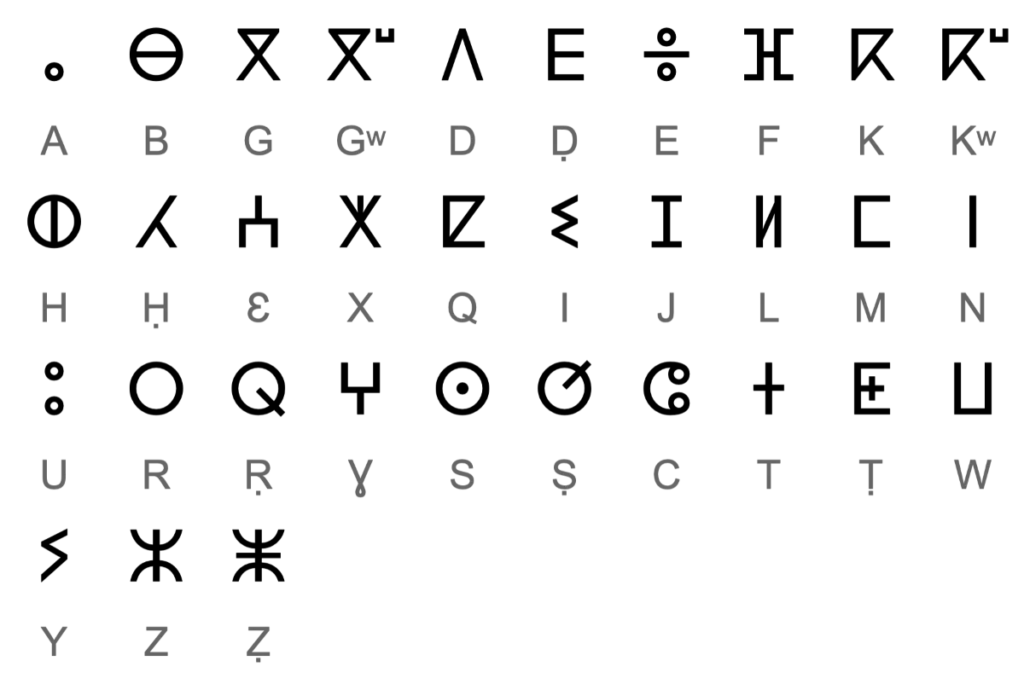
In 2003, Tifinagh-IRCAM was adopted as the official script for Amazigh in Morocco. This choice did not consist simply in taking up an ancient alphabet as it stood. It involved a process of standardisation: selecting characters, adapting them to the needs of Morocco’s Amazigh varieties, enabling teaching, administrative use, typographic reproduction and digital integration.
IRCAM played a central role in this process. Its version of Tifinagh aims to offer a script that is simple, coherent and usable in a modern context. It rests on the historicity of Tifinagh, but also on practical criteria: legibility, economy of signs, phonetic coherence, school use and institutional application.
The constitutional recognition of Tamazight as an official language of Morocco in 2011 reinforced this dynamic. The 2019 organic law then specified the implementation of this official status in education and in priority areas of public life.
One must nevertheless avoid triumphalism. Skounti himself points out that the teaching of Amazigh transcribed in Tifinagh, launched in 2003, remains limited in its progress and territorial reach. The presence of Tifinagh in public space is real, visible and symbolically powerful. But the vitality of a language cannot be measured only by signs, façades or official documents. It depends on schools, books, teachers, family use, literary creation, cultural production and the real desire of speakers.
Tifinagh today: several lives beyond Morocco
The contemporary revival of Tifinagh should not be understood as a reality belonging only to Morocco.
Morocco is today the country where its institutionalisation is most visible. Tifinagh appears there in education, administration, public signage, official cultural media and signposting. But elsewhere in the Amazigh world, its situation is different.
In Algeria, Tamazight is also recognised as a national and official language. Yet the choice of script remains more open. Latin, Arabic and Tifinagh coexist according to uses, regions, institutions and cultural circles. In education and literature, especially in Kabylia, the Latin alphabet remains very present. Tifinagh also exists, but more often in symbolic, associative, militant, educational or heritage uses. It is therefore not absent, but it does not occupy the same institutional place as in Morocco.
In the Tuareg world, the situation is different again. In the Ahaggar, the Ajjer, the Aïr or the Adrar des Ifoghas, Tifinagh is not simply an alphabet reintroduced by a modern cultural policy. It is the trace of a living continuity. The Tuareg have preserved the use of this script through the centuries, for short inscriptions, marks, messages, poems or symbolic uses. It is largely thanks to this Tuareg continuity that Tifinagh never became a mere archaeological relic.
We should therefore speak of several contemporary lives of Tifinagh: an institutional life in Morocco, a plurigraphic life in Algeria, a more limited but real official life in Libya, an ancient and continuous Tuareg life, and finally a digital life now shared by Amazigh communities through fonts, keyboards, social networks and contemporary graphic uses.
This diversity is essential. It shows that Tifinagh does not belong to a single state. It belongs to the long history of the Amazigh world.
Read also : The Berber world
The digital world: a new inscription in time
Unicode standardisation opened another stage in the history of Tifinagh.
As long as a script is not properly integrated into computer systems, it remains difficult to use in word processors, websites, keyboards, databases, fonts, educational tools and digital applications. With its Unicode encoding, Tifinagh entered the global technical space of recognised scripts.
This shift is decisive. It makes it possible to write Tifinagh on computers, create fonts, publish online, develop input tools, circulate texts and imagine new educational or cultural uses.
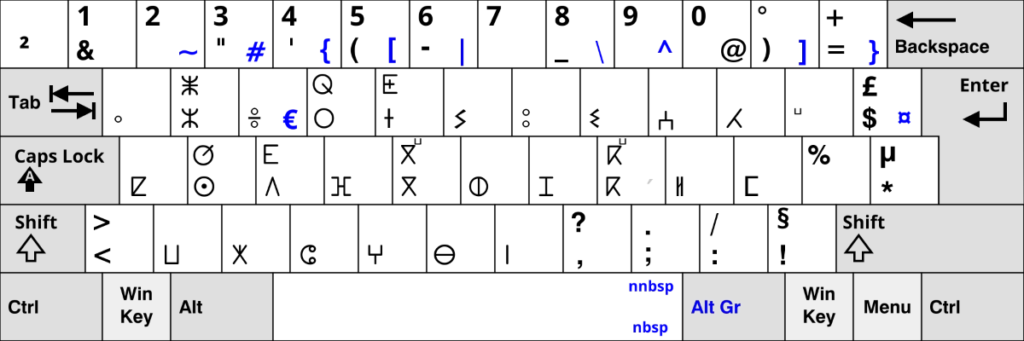
Here again, the symbol is not enough. A script truly exists when it can be used in ordinary gestures: writing a name, composing a message, publishing a text, printing a textbook, displaying a sign, creating a work, archiving a memory.
Digital Tifinagh does not erase carved Tifinagh. It prolongs the same movement in another form: an inscription in time.
An alphabet between identity and use
Tifinagh has become one of the most powerful signs of contemporary Amazigh identity. This is easy to understand. Few graphic forms give such a strong sense of historical continuity. A language can be spoken without being immediately visible. An alphabet, however, appears at once. It marks a space. It transforms a façade, a sign, a poster, a book cover. It says: this language exists, this memory has a form, this culture has a right to be seen.
But this symbolic power also contains a difficulty. If Tifinagh remains only an identity marker, it risks being looked at more than used. The deeper issue is not only to see Amazigh letters in public space. It is to keep Amazigh languages themselves alive.
Skounti expresses this forcefully when he describes the survival of Amazigh as a kind of miracle. This language has crossed the centuries alongside powerful languages: Latin, Arabic, French, Spanish and English. It has resisted through oral transmission, through families, villages, songs, everyday gestures, stories, and through the women and men who passed it on without always having institutions to protect it.
Tifinagh will not save Amazigh on its own. But it can help restore visibility, dignity, tools and horizon.
A memory still open
Tifinagh occupies a singular place in the Amazigh world because it brings together several times.
There is the time of stones, ancient inscriptions, rock engravings and antique monuments.
There is the Tuareg time, that of a living continuity in the Sahara.
There is the time of Amazigh oral tradition, where speech carried memory more widely than writing.
There is the cultural and militant time of modern reappropriation.
There is the institutional time of IRCAM, schools, the Moroccan Constitution and public policy.
And there is the digital time, in which ancient signs become Unicode characters, fonts, keyboards and online content.
It is this superposition of times that gives Tifinagh its strength. It is neither only ancient nor only modern. Neither only scholarly nor only popular. Neither only Moroccan nor only Tuareg. Neither only heritage nor only tool. It stands at the junction of stone, voice, sign and screen.
And this is perhaps why it continues to fascinate.
In the interview granted to sudestmaroc.com, Ahmed Skounti reminds us that there is still much to understand, decipher, compare and transmit. Tifinagh is not a closed file. It is an open memory.
Its future will depend less on the beauty of its signs alone than on the ability of Amazigh societies to make it a living tool: to learn, create, name, write, read and transmit.
Read also : The Tifinagh, the Berber singularity engraved in time
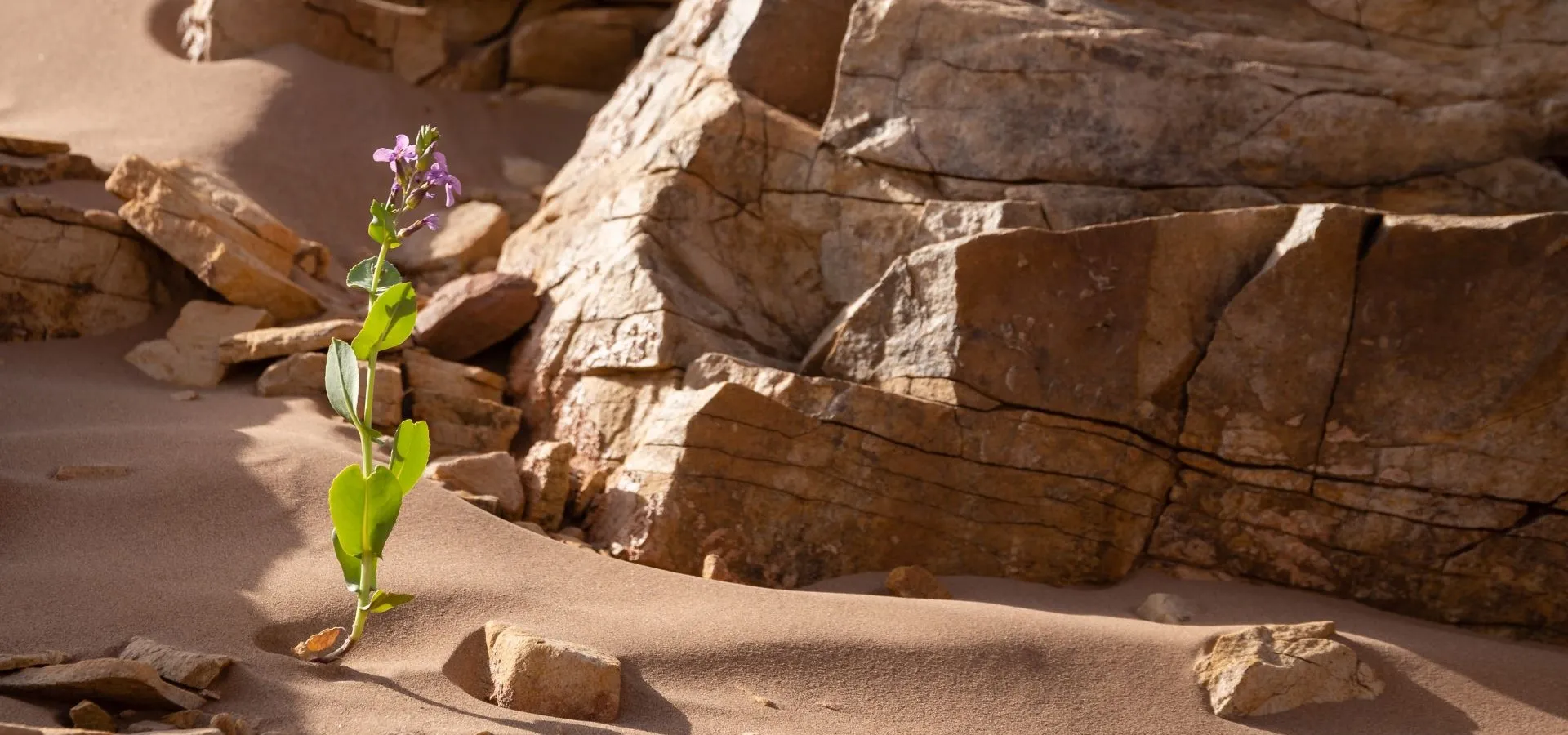
Opening photograph: a rocky site in southern Morocco, in an area where traces of rock art remain. The stone, the sand and fragile life also bear witness to the enduring memory of these symbols. Credit: Abdellah Azizi www.azifoto.com
Key takeaways
- Tifinagh is the alphabet associated with Amazigh / Berber languages.
- Its history goes back to ancient Libyque and Libyco-Berber scripts in North Africa.
- Its territory extends far beyond Morocco: the Mediterranean, the Sahara, the Tuareg world, Algeria, Libya, Niger and Mali.
- Its exact origin remains debated: external influence, local creation, or a combination of both.
- Many ancient inscriptions remain difficult to decipher.
- The Tuareg played a decisive role in the survival of Tifinagh up to the present day.
- Morocco is the country where Tifinagh now has the most visible institutional recognition.
- In Algeria, Tifinagh coexists with the Latin and Arabic alphabets; Latin remains very present, especially in Kabylia.
- Tifinagh is at once a writing tool, an identity symbol and a powerful graphic sign.
- Its future will depend on real uses: education, publishing, creation, digital tools and transmission.